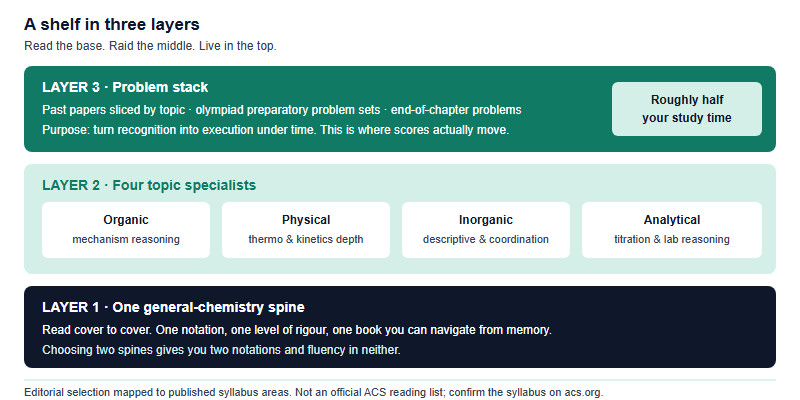
No single textbook covers a chemistry olympiad syllabus, and the students who go looking for one lose a term to the search. What works is a three-layer shelf: one general-chemistry spine you read cover to cover, four topic specialists you raid selectively, and a problem stack where the actual gains are made. Here is how to assemble it.
Why the syllabus needs a shelf, not a book
The awkward fact about chemistry olympiad preparation is that the syllabus straddles two levels. Most of it is general chemistry — stoichiometry, thermodynamics, equilibrium, kinetics, electrochemistry, bonding — but the depth expected in places goes past what an introductory course carries, and topics such as descriptive inorganic chemistry, coordination compounds, spectroscopic reasoning and mechanism-level organic chemistry are thin or absent in general texts entirely.
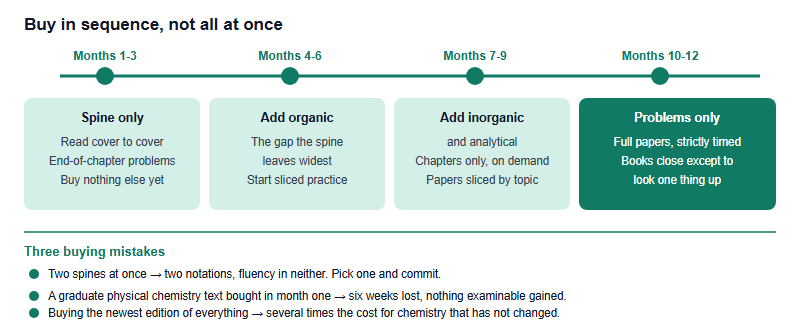
That mismatch produces two predictable failures. The first is the student who works one comprehensive general-chemistry book from front to back, feels prepared, and then meets a paper with an organic mechanism and an inorganic reaction they have never encountered. The second is the student who buys a graduate-level physical chemistry text because the syllabus mentions thermodynamics, spends six weeks on partition functions, and never gets to titration curves.
The fix is structural. One book carries the spine and defines your working level. A small set of specialists exists to be opened at the specific chapters where the spine runs out. And a problem stack sits on top, because reading chemistry and doing chemistry are different activities and only the second one is examined. For the shape of the competition those books are aimed at, see our overview of what the USNCO is. The syllabus itself is ACS territory; check the current topic list on acs.org rather than inferring it from any book.
How we chose, and what this list is not
Book recommendations are the easiest place on the internet to get quietly misled, so it is worth being explicit about method. We mapped the published syllabus areas against widely used English-language chemistry texts and scored each on four things: whether it covers the syllabus area at roughly the right depth, how dense it is in worked examples and end-of-chapter problems, whether a student can use it without a teacher, and whether it is realistically obtainable and affordable for a student in China.
Three disclosures follow from that. This is an editorial selection, not an official reading list — ACS defines the syllabus and does not endorse the books below. There is no single best book, and any honest list has to say where each title is the wrong choice as well as the right one. And we earn nothing from any book recommendation here; there are no affiliate links on this site.
One more caveat that saves money. Editions change, chapter numbers move, and the chemistry in an introductory text does not change materially between editions. An edition or two behind the current one is usually a fraction of the price and entirely adequate. Buy the current edition only when you need to match a class you are actually enrolled in.
Layer one: the general-chemistry spine
Pick exactly one. The point of the spine is a single consistent notation, a single level of rigour, and a single book you can navigate from memory when you are looking something up under time pressure. Two spines means two notations and no fluency in either.
Three spines are worth considering, and the choice is mostly about where you already are.
Zumdahl and DeCoste, Chemical Principles, is a long-standing favourite among olympiad students for a reason: it is noticeably heavier on equilibrium, thermodynamics and acid-base chemistry than a typical introductory text, and the problem sets are demanding. If you are choosing blind and you are reasonably confident in chemistry already, this is the default.
Brown, LeMay and colleagues, Chemistry: The Central Science, is broader and gentler, with better descriptive-chemistry coverage and clearer diagrams. It suits a student who is coming from a school course that felt thin, or whose English is still developing, because the exposition is unusually plain. It will not, on its own, take you to the harder end of the quantitative work.
Oxtoby, Gillis and Butler, Principles of Modern Chemistry, sits at the top of the general-chemistry range and reads as a bridge into physical chemistry. Choose it if you have already finished a solid course and want the spine itself to stretch you. Do not choose it as a first book.
Whichever you pick, read it properly: chapter, worked examples, then the problems, in that order, without skipping to the problems. The spine is the only book on the shelf you owe a full read.
Layer two: the four topic specialists
These are reference books, not reading books. You open them at the chapters where your spine stops, work those chapters hard, and close them again. Trying to read any of them cover to cover is the single most common way to lose a summer.
| Syllabus area | What the spine already gives you | Where to go deeper | The signal that you need the deeper book |
|---|---|---|---|
| Organic chemistry | Functional groups, nomenclature, a handful of named reactions | Klein, Organic Chemistry as a Second Language for skills; Clayden and colleagues, Organic Chemistry, as the mechanism reference | You can name a product but cannot push the arrows that produce it |
| Physical chemistry | Thermodynamics and kinetics at first-course depth | Atkins and de Paula, Physical Chemistry; McQuarrie and Simon, Physical Chemistry: A Molecular Approach | You meet a derivation, not a formula, and cannot follow it |
| Inorganic and descriptive | Periodic trends, some main-group reactions, little coordination chemistry | Housecroft and Sharpe, Inorganic Chemistry; Miessler and colleagues, Inorganic Chemistry | Crystal field splitting, complex geometry or a reaction of a real element stops you |
| Analytical and lab reasoning | Basic titration arithmetic, simple gravimetric ideas | Harris, Quantitative Chemical Analysis | You can compute an equivalence point but cannot reason about indicator choice, error or buffer capacity |
Two notes on how to use the middle layer. Organic is the specialist most students genuinely need, because general-chemistry texts treat it as an appendix while papers treat it as a real topic — and the mechanism-first approach in a skills book transfers far better than memorising reaction lists. Physical chemistry is the specialist most students over-buy: for the overwhelming majority, the physical-chemistry chapters of a strong spine plus a lot of problems beats a graduate reference you open twice.
Analytical chemistry is the quietly underrated one. Harris is written for a laboratory audience, which means it explains why a procedure is designed the way it is — precisely the reasoning a practical or a data-interpretation question is testing, and precisely what a student who has only done classroom titrations has never met.
Layer three: problems, and where the actual gains are
If you take one thing from this article, take the ratio. Reading should be a minority of your hours. A rough working split is a third of the time on the spine and specialists in the first months, dropping steadily, against a rising share on problems, until in the final stretch you are almost entirely solving.
The stack has three tiers, and they are not interchangeable. End-of-chapter problems in your spine build fluency in one topic at a time and give immediate feedback; they are where you should be during a first pass. Olympiad preparatory problem sets — the IChO host country publishes preparatory problems each year, with content and availability varying by year, so check the host’s official channels — are a step up in style, mixing topics and expecting multi-stage reasoning. Past papers are the top tier because they are the only material with the real distribution of difficulty, the real time pressure and the real question phrasing.
The mistake to avoid at the top tier is working papers front to back too early. Until your topic coverage is solid, whole papers mostly tell you what you already know, which is that you have gaps. Slicing is far more efficient: pull only the equilibrium questions from many years and do twenty in a row, and you get repetitions of one question type that a single paper could never provide. Our gathered past-paper collection and the method for working through it is organised for that kind of slicing, with worked solutions for some of the years rather than every one. Switch to whole timed papers only in the last stretch, when the point becomes pacing and stamina rather than content.
Sequencing across twelve months, and three buying mistakes
A shelf assembled all at once mostly sits unread. Buying in sequence, as each layer becomes your actual bottleneck, keeps the cost down and the desk clear.
Two practical points for students in China. First, English-language chemistry vocabulary is a real cost early on, and the fix is not a dictionary habit but a glossary you build yourself as you read the spine — the terms recur relentlessly, so the list converges fast. Second, be careful with translated editions: they are cheaper and easier, but if the paper you are training for is in English, working the problems in translation trains the wrong retrieval pathway. Use a translation to understand a hard passage, then do the problems in English.
One last thing to settle before you build a year around any of this: eligibility. Per ACS, the National Exam requires United States citizenship or permanent residency, and a student who is neither a citizen nor a permanent resident at a school in mainland China has no ACS entry route at all. The exception is a US citizen or green-card holder enrolled for at least a year at an accredited American school abroad, including in China, and under twenty, who competes through an ACS International Chemical Sciences Chapter. There is no separate China region to register for. What remains genuinely valuable is the preparation itself — the syllabus is an excellent map of serious chemistry, and this shelf serves school examinations, other competitions you are eligible for and first-year university equally well. The full position is set out in our guide to who can and cannot enter the USNCO; eligibility is ACS territory, so confirm current rules on acs.org.
Frequently asked questions
Which single book should I start with?
One general-chemistry spine, read cover to cover. Zumdahl suits confident students; Brown suits those rebuilding foundations first.
Do I need a graduate physical chemistry textbook?
Almost never. A strong spine plus heavy problem practice beats a reference book you open twice and cannot follow.
Are older editions acceptable?
Yes. Introductory chemistry does not change materially between editions, and an older edition costs a fraction as much.
How much time should go on reading versus problems?
Reading dominates the first months and should shrink steadily. By the final stretch you should be almost entirely solving problems.
This is the USNCO information desk, synchronising official ACS information for chemistry students in China, operated by Hanlin Education. The USNCO is run by the American Chemical Society (ACS), which sets all official rules and eligibility. Always confirm current details on acs.org. Errors reported to us are corrected within 7 working days.