For many Chinese students, the first obstacle in a USNCO past paper is not the chemistry — it is the English. Sixty multiple-choice questions in 90 minutes leaves roughly 90 seconds each, and a student who must decode “titrant,” “supernatant,” or “account for” on the fly loses time the chemistry never gets back. This guide is a terminology bridge: five vocabulary families, the command words decoded, and a four-week reading drill built on released papers.
Why language costs more marks than students admit
The USNCO national exam — run by the American Chemical Society (ACS) since 1984 — packs its 60-question multiple-choice section into 90 minutes, followed by a written free-response section. (For the full structure, see our foundation guide to what the USNCO is.) Under that clock, reading is not a passive step before the chemistry; it is part of the chemistry. In the timed sittings we review with students in China, three language failure modes come up again and again:
- Vocabulary stalls. The student knows the concept — 滴定, 缓冲溶液, 歧化 — but takes 10–20 seconds to map “titration,” “buffer,” or “disproportionation” onto it. Twenty such stalls is six minutes gone.
- Command-word misreads. “Estimate” is answered with a full calculation; “account for” is answered with a restatement instead of a cause. On free-response items, this loses credit even when the underlying chemistry is right.
- Distractor traps that live in the wording. Options that hinge on “least” vs “most,” “increases” vs “increases most rapidly,” or “at equilibrium” vs “initially” punish skimming in a second language.
The good news: this is the most fixable weakness in olympiad prep. Chemistry depth takes years; exam English takes weeks of targeted work, because the vocabulary of the USNCO is finite, recurring, and fully visible in 25+ years of released papers.
The five vocabulary families of a USNCO paper
Rather than memorising an alphabetical word list, learn the vocabulary the way the exam deploys it — in five functional families. Each family behaves differently under time pressure and deserves a different study treatment.
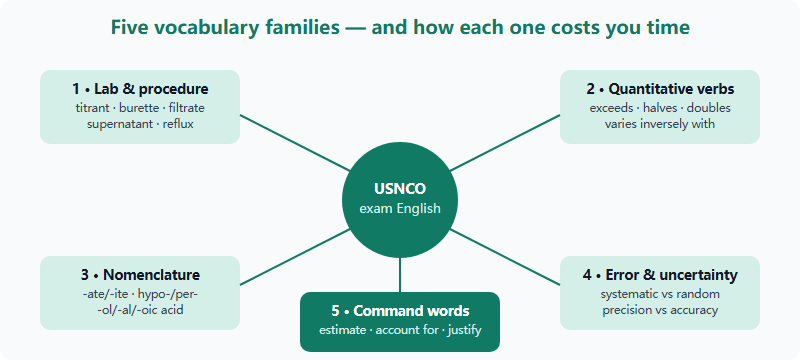
A bilingual anchor table for the highest-frequency offenders — the terms our students most often stall on in timed sittings:
| English term | 中文 | Trap note |
|---|---|---|
| titration / titrant / analyte | 滴定 / 滴定剂 / 被测物 | Titrant is in the burette; analyte is in the flask. Options often swap them. |
| buffer (solution) | 缓冲溶液 | As a verb too: “the solution is buffered at pH 5.” |
| precipitate / supernatant | 沉淀 / 上清液 | “Precipitate” is noun and verb; read which one the sentence needs. |
| disproportionation | 歧化反应 | One species is both oxidised and reduced — not just “two products form.” |
| volatile | 易挥发的 | Means “evaporates readily,” not “unstable” or “explosive.” |
| rate constant vs equilibrium constant | 速率常数 vs 平衡常数 | Both written k/K; the capital letter and context decide. Misreading this sinks whole questions. |
| hypochlorite / chlorate / perchlorate | 次氯酸盐 / 氯酸盐 / 高氯酸盐 | hypo- = fewer O, per- = more O. The prefixes encode oxidation state. |
| aliquot | 移取的一份(等分试样) | A measured portion taken for analysis; appears constantly in lab-context items. |
| anhydrous / hydrate | 无水的 / 水合物 | Mass-percent questions turn on spotting “anhydrous” in the stem. |
| accuracy vs precision | 准确度 vs 精密度 | Accuracy = close to true value; precision = close to each other. English distinguishes them strictly. |
Command words decoded: what each verb obliges you to do
On the written free-response section, the command word is the grading contract. Answer a different verb than the one printed and you can lose credit while being “right.” The recurring set is small:
- Calculate / determine — show quantitative work leading to a value with units. “Determine” may also accept a rigorous logical derivation.
- Estimate — a justified approximate value. Spending four minutes on an exact computation here is time lost, not rigour gained.
- Explain / account for — give the cause, not a restatement. “The boiling point is higher because it is larger” fails; naming the stronger dispersion forces passes.
- Justify / support your answer — your claim plus the evidence or principle that compels it. An unsupported correct claim is an incomplete answer.
- Predict — state the expected observation or outcome before (or without) being told the result.
- Sketch — a drawing with labelled axes and correct qualitative shape; exact values usually optional unless demanded.
A drill that works: take one free-response question from a released paper, cover the solution, and write only the skeleton of an answer — one line naming what the command word obliges you to produce. Ten minutes a day of skeleton-writing rewires the reflex faster than full written answers do.
A 4-week reading drill built on past papers
This drill separates the language variable from the chemistry variable, then re-merges them under time. It assumes access to released exams — our gathered pack covers 1999–2025 with worked solutions for many of the years (message us to get it), and this guide explains the overall study method for the pack.
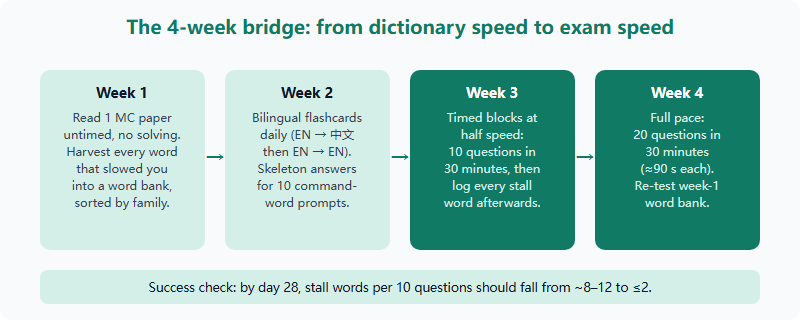
Two refinements make the drill stick. First, in Week 2, force the second flashcard pass to be English-to-English (“titrant → the solution delivered from the burette”) — the goal is thinking inside English, not translating through Chinese during the exam. Second, keep the stall-word log honest: a word counts as a stall if it cost you more than about three seconds, even if you eventually got it. The log, not the flashcard deck, tells you what to review.
Where this fits in the bigger picture
Language work is a multiplier, not a substitute. It converts chemistry you already know into marks you actually collect — it will not rescue a topic you have never studied. Sequence it early: the four-week bridge is ideal summer work before a season of serious timed practice, and it pays off across every English-medium chemistry context you will meet later, from IB/AP extended work to university lab manuals. One caution specific to our readers: building exam English on USNCO papers does not change eligibility — the competition itself remains open to U.S. high-school students through ACS Local Sections, as we explain in our honest eligibility guide. The papers are your training standard; the language skills are yours to keep everywhere.
FAQ
How much time can better exam English realistically save on the multiple-choice section?
Students who cut stall words from ~10 to ~2 per 10 questions typically recover several minutes across a 60-question sitting — often the margin for 3–5 extra attempted questions.
Should I annotate past papers in Chinese while learning?
Early on, yes — bilingual anchors speed acquisition. By Week 3, switch margin notes to English so exam-day thinking never routes through translation.
Is USNCO vocabulary different from AP Chemistry vocabulary?
The core overlaps heavily, but USNCO papers use more lab-procedure and uncertainty language, and free-response command words are enforced more strictly.
Where do I get the past papers for this drill?
We maintain a gathered pack of released exams from 1999–2025, with worked solutions for many of the years — message us and we will send it, with the specific set confirmed by your teacher.
This page is maintained by the USNCO information desk, which synchronises official ACS information for chemistry students in China and is operated by Hanlin Education. The U.S. National Chemistry Olympiad is run by the American Chemical Society (ACS), which sets all official rules, dates, and eligibility requirements — always confirm current details on acs.org. If you spot an inaccuracy, we correct verified errors within 7 working days.