Most students studying in mainland China cannot enter the USNCO — entry runs through ACS Local Sections, and the route for students abroad requires U.S. citizenship or a green card. But that does not make USNCO-level preparation useless for admissions. Done honestly, the prep itself — mastery above AP level, a documented mock-exam record, club leadership — becomes concrete application evidence. This guide shows exactly what to build, how to phrase it, and what never to claim.
First, the honest baseline: what you can and cannot say
The eligibility line is not negotiable, and admissions officers can check it. The U.S. National Chemistry Olympiad, run by the American Chemical Society (ACS) since 1984, selects the four-student Team USA for the International Chemistry Olympiad. Entry is never an individual online sign-up: it runs through an ACS Local Section, or, for students outside the United States, through an ACS International Chemical Sciences Chapter. Which route is open to you depends on your case. Per ACS, a student at a high school in the U.S. may sit the Local Exam whatever their nationality, but only U.S. citizens and permanent residents can be nominated for the National Exam, regardless of score. A U.S. citizen or green-card holder enrolled for at least a year at an accredited American school abroad — which includes American and international schools in China — has the full route, National Exam included. A student who is neither a citizen nor a permanent resident and studies in mainland China has no ACS route at all; the released papers and the syllabus are still completely open. We cover the full picture in our honest guide to USNCO eligibility for international students.
If you are in that last position — as most of our readers are — two sentences must never appear in your application:
- “I participated in the USNCO” — false, and easily flagged.
- “I placed in the top X% of the USNCO” — there is no such score for you to cite.
What you can say, truthfully and specifically: “I trained against the USNCO syllabus and released national exams (1999–2025), scored X/60 on timed past papers under exam conditions, and taught the hardest topics to my school’s chemistry club.” Every clause in that sentence is verifiable from your own records. Honesty is not just an ethics point here — specific, checkable claims read as more credible than vague competition name-dropping. If you are new to the competition itself, start with our foundation guide to what the USNCO is.
Why USNCO-level prep is a real signal at all
Admissions readers are trying to answer one question about a prospective chemistry, chemical engineering, or pre-med applicant: did this student go meaningfully beyond their school curriculum, by choice? USNCO material answers that almost by construction:
- It sits above AP Chemistry. The national exam’s free-response section demands multi-step quantitative reasoning and written justification that AP’s format rarely requires at the same depth.
- It has a public, stable syllabus and 25+ years of released papers. A student who works through the 1999–2025 released exams has a self-directed curriculum with built-in measurement — not a vague claim of “self-studied advanced chemistry.”
- It is timed and scored. 60 multiple-choice questions in 90 minutes is a hard, quantifiable standard. Your trajectory on that standard — say, 31/60 in September to 47/60 in March — is a growth story told in numbers.
None of this guarantees any admissions outcome — nothing does, and any service promising otherwise should be treated with suspicion. The claim here is narrower and defensible: self-directed work against a recognised external standard is exactly the kind of evidence selective programmes ask for, and USNCO materials are among the best-documented standards available to a chemistry student anywhere in the world.
Five artifacts to build — and where each one goes in the application
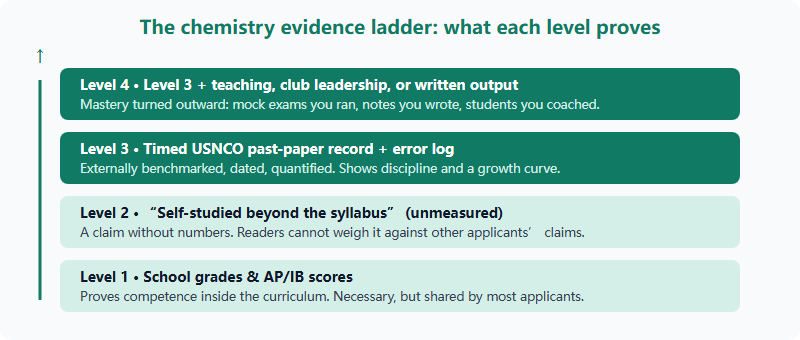
An “artifact” is anything a third party could, in principle, inspect. Vibes are not artifacts; dated spreadsheets are. Here are the five we recommend building over a 12–18 month window, mapped to where they surface in a typical U.S.-style application.
| Artifact | What it looks like concretely | Where it appears |
|---|---|---|
| 1. Timed past-paper score log | A dated spreadsheet: paper year, raw score /60, conditions (90 min, closed book), topic-level error tally | Activities list description; quantified in 150 characters (“raised timed USNCO past-paper score 31→47/60 over 14 sittings”) |
| 2. Error log & topic notebook | A living document reorganising your mistakes by topic (equilibrium, electrochemistry, organic), each with a rewritten correct solution | Raw material for essays and interviews — the “how I actually learn” story |
| 3. Chemistry club or study group leadership | You founded or led sessions; you set problems, ran a mock exam, kept attendance | Activities list (leadership slot); teacher recommendation corroborates it |
| 4. Written or taught output | Topic guides you wrote for classmates, a recorded walkthrough of a hard free-response problem, school newsletter piece | Additional-info section or portfolio link, where the platform allows one |
| 5. Teacher-verified mock under exam conditions | Your chemistry teacher proctors one full timed sitting and can vouch for the conditions | Teacher recommendation letter — the strongest corroboration available to you |
Notice what ties the five together: every artifact is something you own and can date, and at least two of them (3 and 5) recruit an adult witness. That combination — self-generated evidence plus adult corroboration — is what separates a credible narrative from an unverifiable one. Our gathered pack of released USNCO exams from 1999–2025, with worked solutions for many of the years, is the raw material for artifacts 1 and 2; this guide explains how to work through the pack productively, and you can message us to get it.
The 18-month build: a realistic timeline
The single most common failure mode we see is compression: a student discovers this strategy in the autumn of their application year and tries to manufacture a record in eight weeks. Score logs with 14 dated sittings across a year read very differently from logs with 14 sittings across a month. Start early and let time do the authenticating.
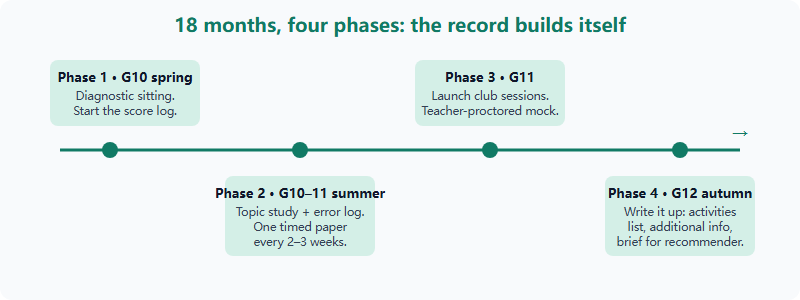
Three practical notes on the timeline. First, the diagnostic sitting in Phase 1 should be a real released paper under real timing, even though the score will sting — that low first data point is what makes the later curve meaningful. Second, in Phase 3, the teacher-proctored mock matters more than students expect: it upgrades your whole log from “self-reported” to “witnessed once under stated conditions, consistent with the rest.” Third, in Phase 4, give your recommender a one-page brief listing dates, scores, and what you taught — teachers write concrete letters when you hand them concrete material.
Phrasing that survives scrutiny: three templates
The gap between an honest record and a misleading one is often a single verb. Here are three phrasings that state the truth precisely, with the failure versions alongside.
- Activities list: “Self-directed olympiad chemistry: trained on the USNCO syllabus and released exams (1999–2025); raised timed multiple-choice score from 31 to 47/60 across 14 proctored and self-timed sittings.” Not: “USNCO competitor.”
- Additional info: “I am not eligible to enter the USNCO — it runs through ACS Local Sections in the U.S., and the route for students abroad is open only to U.S. citizens and permanent residents at accredited American schools; I used its released exams as an external benchmark instead.” Naming the limitation yourself converts it from a red flag into evidence of integrity. Check that the sentence is actually true of you before you copy it: if you hold a U.S. passport or a green card and attend an accredited American school abroad, you may be eligible to compete, and this framing would be inaccurate — look at entering rather than benchmarking.
- Interview answer: “I couldn’t sit the exam, so I made the released papers my standard — here’s the topic that broke me for two months and how I fixed it.” Then tell the equilibrium story from your error log.
One more compliance note, because it matters: if you also enter olympiads that are open to students in China, report those results under their own names and never re-label them. A certificate from one competition presented under another competition’s name is fabrication, full stop.
FAQ
Can a student in China register for the USNCO through any channel?
There is no individual sign-up form anywhere; entry is arranged by an ACS Local Section or, abroad, by an ACS International Chemical Sciences Chapter. For a student who is neither a U.S. citizen nor a green-card holder, there is no ACS route. A U.S. citizen or permanent resident enrolled for at least a year at an accredited American school in China can compete through such a chapter. Confirm current eligibility rules on acs.org.
Is it dishonest to mention the USNCO in my application if I never sat it?
Not if you are precise: say you trained on its syllabus and released exams, state your timed scores, and name the eligibility limit yourself. Never imply participation.
How many timed past-paper sittings make a credible score log?
There is no magic number, but 10–15 dated sittings spread over 9–18 months shows sustained work. A burst of sittings crammed into one month reads as manufactured.
Does USNCO-level prep guarantee an admissions edge?
No preparation guarantees any admissions outcome. It provides measurable evidence of self-directed work above curriculum level — that is all, and that is enough to be worth doing.
This page is maintained by the USNCO information desk, which synchronises official ACS information for chemistry students in China and is operated by Hanlin Education. The U.S. National Chemistry Olympiad is run by the American Chemical Society (ACS), which sets all official rules, dates, and eligibility requirements — always confirm current details on acs.org. If you spot an inaccuracy, we correct verified errors within 7 working days.