Part I of the USNCO National Exam is a 60-question multiple-choice paper with a 90-minute limit — roughly 90 seconds per question. It rewards a wide, secure command of the syllabus and fast recognition far more than deep work on any single problem. This is the part where pacing, question-type identification, and disciplined guessing decide the score. Here is how the paper is built and how to train for it, with the official format always to be confirmed on acs.org.
What Part I actually is, and where it sits
The USNCO National Exam, run by the American Chemical Society (ACS), is a three-part assessment: a 60-question multiple-choice paper (90 minutes), a free-response written paper (105 minutes), and a laboratory practical (90 minutes), totalling about four and a half hours. Part I — the multiple-choice section — comes first and sets the tone. A periodic table is provided, so what the clock rewards is memorised process, not memorised data. For the full structure of all three parts, see our companion explainer, Inside the USNCO National Exam; this article zooms in on Part I alone.
One honesty note up front, because the audience here is different from the contestants. Who may sit this paper is set by ACS, and it turns on status rather than location alone: the National Exam requires U.S. citizenship or permanent residency, so a student in mainland China who holds neither has no route to it, while a U.S. citizen or green-card holder enrolled at an accredited American school abroad does compete — through an ACS International Chemical Sciences Chapter. Either way, entry runs through a coordinator — a Local Section or an International Chapter — and not an individual sign-up form. For most readers here the paper is therefore something you use to prepare rather than to enter, and that value is real: the public USNCO multiple-choice papers are among the best chemistry drills available, and the 90-second discipline they teach transfers directly to AP, A-Level, IB and university chemistry. For the eligibility detail in full — including the Local Exam route open to a non-U.S. national at a high school inside the United States — read whether international students can take the USNCO.
The arithmetic of 90 seconds
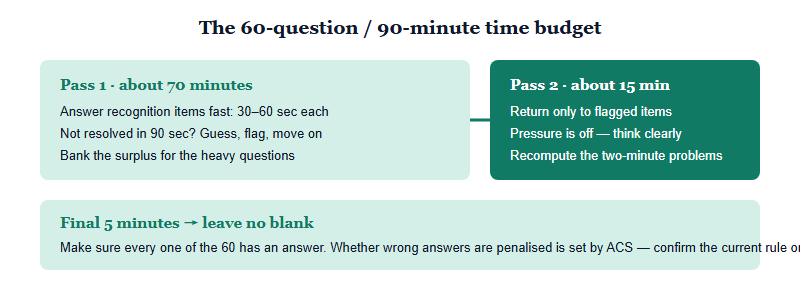
Sixty questions, ninety minutes. The average is ninety seconds per question, but the truth is more useful than the average: a well-paced student spends thirty to forty seconds on recognition questions and banks the surplus for the four or five genuinely heavy items that need two minutes of calculation. The paper is not a marathon at constant speed; it is a budgeting exercise. The single most common way strong chemists lose marks on Part I is not a knowledge gap — it is spending three minutes early on one stubborn equilibrium question and then rushing the final ten items they would otherwise have answered correctly.
The fix is a fixed rule decided before you sit down: on any question that has not resolved within about ninety seconds, mark your best current guess, flag it, and move on. You return on a second pass with the clock pressure relieved. This converts the paper from one long anxious push into two calmer sweeps, and it protects the easy marks at the end — which are worth exactly as much as the hard ones in the middle.
The topic spread — and what the breadth means
Part I ranges across the whole of a strong general-chemistry course. It does not cluster on one favourite area; the design goal is breadth, so a single weak topic costs you several scattered questions you cannot dodge. The table below groups the kinds of content a candidate should expect to meet, synced from official ACS descriptions of the syllabus. Treat it as orientation, not a fixed weighting — ACS sets and can adjust the emphasis, so confirm the current syllabus on acs.org.
| Cluster | Typical Part I content | What gets tested fast |
| Quantitative core | Stoichiometry, limiting reagent, solution concentration, gas laws | Set-up recognition; unit cancelling |
| Structure & periodicity | Atomic structure, electron configuration, periodic trends, bonding | Trend direction; recall of rules |
| Energy & equilibrium | Thermochemistry, Hess's law, equilibrium, acid–base, solubility | Which principle applies; sign logic |
| Dynamics & redox | Kinetics, reaction mechanisms, electrochemistry, redox balancing | Rate-law reading; half-reaction recall |
| Organic & descriptive | Functional groups, basic reactions, descriptive and main-group chemistry | Pattern matching; nomenclature |
The strategic reading of that table is simple: because the questions are spread thin and the clock is tight, your weakest cluster is your real ceiling on Part I. A student who is brilliant at organic but shaky on electrochemistry will lose the electrochemistry questions and waste time second-guessing them. Breadth, not depth, is what the multiple-choice paper measures — which is also exactly why it is such a good diagnostic for a self-studier.
How to drill Part I with past papers
The multiple-choice papers are where past-paper practice pays back fastest, because the format is so stable and the feedback is instant — you are either right or wrong, with no marker in between. Hanlin has gathered a free practice pack of past USNCO papers (questions plus answer keys, with worked solutions for many of the years; coverage of full solutions varies by year and is being added to, so treat what the teachers send as the reference). The point of the pack is to let you build the two-pass instinct under a real clock rather than learning it for the first time on exam day.
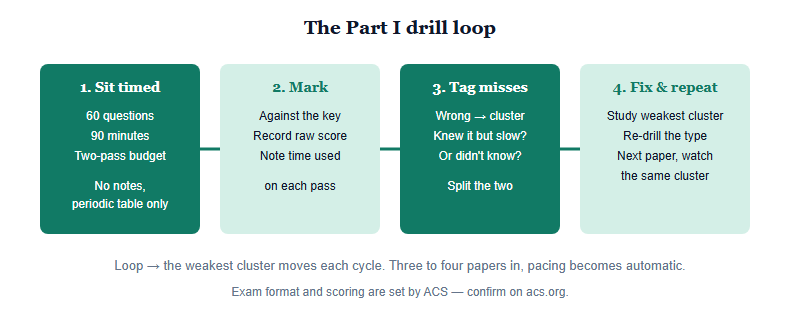
- Always time it. An untimed multiple-choice paper teaches the wrong habit. Set 90 minutes for 60 questions and feel where the surplus and the squeeze fall.
- Log the misses by cluster. After each paper, tag every wrong answer to one of the five clusters above. Three papers in, your weakest cluster is obvious — that is your study list.
- Separate “didn't know” from “ran out of time.” These need different fixes. The first is a content gap; the second is a pacing gap. Confusing them is why students re-study material they already know.
- Re-drill the question type, not the question. Once you have seen a limiting-reagent item, the value is recognising the next one in ten seconds — not memorising that specific answer.
For a full method on getting value out of the archive — not just Part I — see our guide to USNCO past papers and how to use them. The multiple-choice section is simply the part of that archive with the highest return per hour for a self-studier, because it sharpens pace and exposes content gaps at the same time.
A short FAQ
How many questions and how long is the USNCO multiple-choice paper?
Part I of the National Exam is 60 multiple-choice questions in 90 minutes — about 90 seconds each. Confirm the current format on acs.org.
Is a calculator or periodic table allowed?
A periodic table is provided; the timing rewards memorised process over data. Calculator and other allowances are set by ACS — confirm on acs.org.
Are wrong answers penalised on Part I?
The scoring rule is set by ACS and can change year to year. Confirm the current penalty policy on acs.org before deciding whether to guess on every item.
Can a student in China sit the USNCO multiple-choice paper?
It depends on status, not location alone. Part I belongs to the National Exam, which ACS restricts to U.S. citizens and permanent residents — so a student in mainland China who is neither has no route to it, and uses the public papers to prepare rather than to enter. A U.S. citizen or green-card holder enrolled at an accredited American school abroad can compete through an ACS International Chemical Sciences Chapter, National Exam included. A non-U.S. national at a high school inside the United States may sit the Local Exam, but cannot be nominated to the National Exam whatever the score. Confirm your own case on acs.org.
This is the USNCO information desk synchronising official ACS information for chemistry students in China, operated by Hanlin Education. The USNCO is run by the American Chemical Society (ACS), which sets all official rules, formats and eligibility; the figures here are for orientation only. Always confirm current details on acs.org. Any error will be corrected within 7 working days.