The USNCO and the IChO are two different exams on one ladder. The USNCO is the American Chemical Society (ACS) national competition that selects the U.S. team; the IChO (International Chemistry Olympiad) is the global final that team then competes in. They differ in length, structure, scoring and scope — the IChO is longer, deeper and more lab-weighted. Here is the side-by-side.
National qualifier vs international final
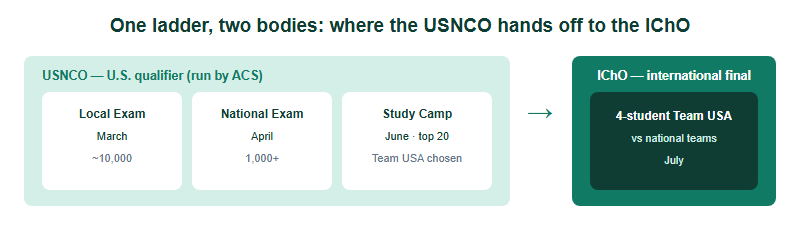
The relationship is sequential, not parallel. The USNCO runs each year inside the United States to find and rank the best high-school chemists, narrowing roughly 10,000 Local entrants down to a four-student Team USA. Those four then travel to the IChO, where they compete against national teams from dozens of countries. So the USNCO is the selection exam; the IChO is the destination. We trace that full progression in our companion piece on the road from the USNCO to the IChO; this article focuses specifically on how the two exams themselves compare. The distinction matters because the two are scored on completely different bases — the USNCO ranks students within one country to pick a team, while the IChO awards gold, silver and bronze medals across the whole field of competing nations according to where each student falls in the international score distribution.
One point of honesty up front, because the audiences differ. The USNCO is for U.S. high-school students, entered through an ACS Local Section — there is no individual sign-up from abroad. The IChO is contested by national teams, each country running its own selection. For a student in China, neither is something you enter through this desk; the value of understanding both is to see the full international standard in competition chemistry, and to use the public USNCO papers to train toward it. For the basics, start with our guide to what the USNCO is and the honest detail on whether international students can take it.
Side by side: the two exams
The table below compares the structures. The USNCO figures are synced from official ACS information; the IChO figures reflect its published format. Both bodies set their own rules and can change them year to year — confirm USNCO details on acs.org and IChO details on the official IChO channels.
| USNCO (National Exam) | IChO (international final) | |
| Role | U.S. national qualifier | International final |
| Run by | American Chemical Society (ACS) | The International Chemistry Olympiad |
| Who competes | U.S. high-school students (via ACS Local Section) | National teams (up to four students each) |
| Structure | Three parts: 60 multiple-choice (90 min) + free-response (105 min) + lab practical (90 min) | Two exams on separate days: theoretical + practical |
| Approx. length | ~4.75 hours total | Theoretical ~5 hours; practical ~5 hours |
| Scoring weight | Combined across the three parts (set by ACS) | Theoretical 60% · practical 40% (total 100) |
| Recognition | Top 50: High Honors; next 100: Honors | Gold / silver / bronze medals by score distribution |
Figures are for orientation and can change each year. The authority for USNCO is ACS (acs.org); the authority for the IChO is its own official organisation. Confirm before relying on any specific number.
The big structural differences
Three differences matter most when you compare the exams as experiences, not just on paper. They explain why the IChO is a genuine step up in demand from even the National Exam.
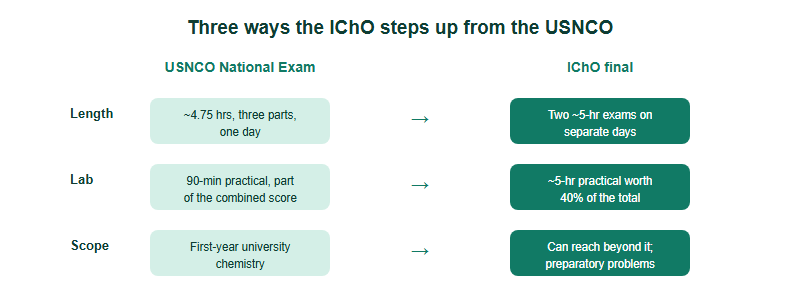
- Length and stamina. The USNCO National Exam runs about 4.75 hours across three parts in a single day. The IChO splits into two roughly five-hour exams on separate days — a theoretical paper and a practical. The international final is, simply, far longer and demands sustained endurance.
- How much the lab counts. Both value bench skill, but the IChO weights it heavily: its practical is around five hours and worth 40% of the total, with the theoretical paper the other 60%. The USNCO’s 90-minute practical is one of three combined parts. At the IChO, you cannot medal on theory alone.
- Scope and preparation. The USNCO is built on a first-year university chemistry syllabus. The IChO can push beyond standard first-year material, and it publishes a preparatory problem set in advance so teams can train on the specific advanced topics that year’s host may examine.
Why the laboratory weighting changes everything
Of all the differences, the one most students underestimate is how much the laboratory counts at the IChO. When the practical is worth 40% of the total, theory alone — however strong — cannot carry you to a medal. A competitor who is brilliant on paper but weak at the bench is capped, and many strong national-level chemists discover this only when they reach the international stage. The USNCO already signals this priority by including a graded practical at all; the IChO simply turns the dial much further.
This has a direct lesson for anyone training toward the standard, even on paper. Do not treat the lab as optional. You may not be able to run an IChO-grade experiment at home, but you can study practical questions seriously: read each procedure, predict the measurements, work the data-analysis and uncertainty steps, and rehearse the reasoning examiners reward. Our companion guides — the overview of the USNCO and the detail on who can take it — both stress the same point: written brilliance is only part of the picture, and the gap between a good national candidate and an international one is very often the laboratory.
What this means if you are training from abroad
For a student in China, neither exam is one you sit through this desk — but the comparison is still useful, because it sets the ceiling. If your aim is to reach a genuinely international standard in chemistry, the IChO format tells you what that standard looks like: long, lab-heavy, and willing to go beyond first-year content. The USNCO past papers (1999–2025), released publicly by ACS with answer keys, are an ideal training ground toward that ceiling — calibrated, rigorous and free to study.
A sensible progression is to build a National-Exam-level base first — full timed multiple choice, disciplined free-response writing, and as much practical reasoning as you can rehearse on paper — and only then look at IChO-style preparatory problems for additional depth. We lay out the paper-driven method in our guide to using USNCO past papers to prepare.
A realistic way to gauge where you stand is to use the two exams as two yardsticks. First, can you complete a full USNCO National-style written paper under time and mark yourself respectably against the answer key? That is the national-qualifier bar. Only once that is comfortable does the IChO yardstick — longer papers, deeper organic and inorganic content, a heavily weighted practical — become a meaningful target rather than a discouraging one. Trying to leap straight to international-standard problems before the national base is solid is the most common way self-studiers burn out; the ladder exists for a reason, and it is just as useful as a training sequence as it is as a competition pathway.
The honest summary: you may not compete in either exam, but you can absolutely train to their standard, and doing so is one of the strongest things a serious chemistry student can do for both university applications and real subject mastery. Whether your ceiling is the national paper or the international one, the route is the same — sustained, paper-driven practice with the lab taken seriously, not a last-minute sprint.
Frequently asked questions
What is the difference between the USNCO and the IChO?
The USNCO is the U.S. national qualifier run by ACS; the IChO is the international final where the resulting Team USA competes against national teams. The IChO is longer, more lab-weighted and broader in scope.
Is the IChO harder than the USNCO?
Generally yes. It runs two roughly five-hour exams on separate days, weights the practical at 40%, and can reach beyond first-year university chemistry — a clear step up from the national exam.
How is the IChO scored?
By its published format, the theoretical exam is worth 60% and the practical 40%, totalling 100. Rules are set by the IChO and can change — confirm on the official IChO channels.
Can a student in China sit the USNCO or IChO?
Not through this desk. The USNCO is for U.S. high-school students via an ACS Local Section; the IChO is contested by national teams. From abroad, use the public papers to train. Confirm eligibility on acs.org.
This is the U.S. National Chemistry Olympiad (USNCO) information desk, synchronising official ACS information — dates, rules, the syllabus, past papers and results — for chemistry students in China, operated by Hanlin Education. The USNCO is run by the American Chemical Society (ACS), which sets all official rules and eligibility; the International Chemistry Olympiad sets its own rules. Always confirm current details on acs.org. Confirmed errors are corrected within 7 working days.