
Laboratory questions on the USNCO’s written papers reward decisions more than bench hours. They ask which piece of apparatus a job needs, which separation exploits the property that differs, and which way a procedural slip moves a calculated result. All three can be learned at a desk, which matters if your timetable has little practical time. This guide teaches each one with worked cases.
What a written laboratory question is really asking
The USNCO does have a hands-on component, but most candidates never meet it. ACS lists the laboratory work as Part III of the National Exam, two laboratory practicals in 90 minutes, sat only by National nominees. The Local Section Exam, 60 multiple-choice questions in 110 minutes, has no practical at all, yet it still examines laboratory judgement on paper. On the 2025 Local Section Exam, which we worked through question by question, the descriptive and laboratory questions included choosing the right glassware to make up a solution of a stated concentration, deciding what the final rinse of a burette should be, and judging from a table of repeated weighings when heating to constant mass could stop. For how the exam’s parts fit together, see what the USNCO is.
Questions like these fall into three families, and each has its own reasoning:
| Family | The decision | The reasoning that answers it | First drill |
|---|---|---|---|
| Apparatus | Which item, and how it should be prepared | Match the precision to whether the quantity enters a calculation | Sort six items by what each one measures well |
| Separation | Which technique suits a given mixture | Name the property that differs; the technique follows | Name the property for eight mixtures before choosing |
| Error direction | Too high, too low or unchanged | Trace the changed quantity through the equation actually used | Write five slips a week and push each through its equation |
Apparatus: match the precision to the job
Glassware is designed for jobs, and a question asking which item to use is really asking whether the volume will enter a calculation. The tolerances below are typical figures for Class A glassware; every item is marked with its own, and Class B is roughly twice as loose.
| Item | The job it is built for | Typical Class A tolerance | Use it when |
|---|---|---|---|
| Volumetric flask, 100 mL | Making up a solution to one exact volume | ±0.08 mL | A stated concentration must be prepared accurately |
| Volumetric (bulb) pipette, 25 mL | Delivering one fixed aliquot | ±0.03 mL | An exact volume of sample goes into a titration |
| Burette, 50 mL | Delivering a variable, measured volume | ±0.05 mL | The volume of titrant is the measurement |
| Graduated cylinder, 100 mL | Measuring an approximate volume quickly | ±0.5 mL | A reagent is added in excess and its exact volume never enters the calculation |
| Beaker or conical flask | Holding, mixing, heating, titrating into | Markings only approximate, often about ±5% | Never for a volume you will calculate with |
Preparation matters as much as choice, and the rinsing rules follow from one question: does leftover water change the number of moles that end up in the calculation?
- Burettes and pipettes get a final rinse with the solution they are about to deliver. Water left inside would dilute it, so the concentration you think you are delivering would no longer be true.
- Conical flasks and volumetric flasks are rinsed with distilled water only. Water already in a titration flask changes the volume but not the moles of analyte you pipetted in, and a volumetric flask is filled to the mark with water anyway.
- Heating to constant mass is finished when two consecutive weighings, each taken after cooling, agree within the precision of the balance. One reading lower than the last proves only that the sample is still losing mass. Cool in a desiccator: a warm crucible reads light because of rising air, and an anhydrous solid left in the open takes water back.
- Burette readings are taken at eye level from the bottom of the meniscus and recorded to two decimal places, the second one estimated: 22.40 mL, not 22.4.
Safety questions run on the same principle of knowing the reason. Concentrated acid is added to water, slowly and with stirring, because dilution releases a great deal of heat and water poured onto acid can boil at the surface and spatter. A closed system is never heated, because gas expands and pressure builds. Volatile toxic or corrosive substances, such as concentrated hydrochloric acid, ammonia or bromine, belong in a fume cupboard, and a smell is wafted towards you rather than inhaled over the container. Volatile organic solvents such as diethyl ether stay away from flames and are warmed in a water bath.
Separations: name the property that differs, then choose
Separation questions look like a list of techniques to memorise, but they are one decision. Ask what is different about the components: one does not dissolve, one boils lower, one dissolves far better when hot, the two liquids form layers, the solute prefers another solvent, or the components cling differently to a stationary phase. The technique follows from the answer.
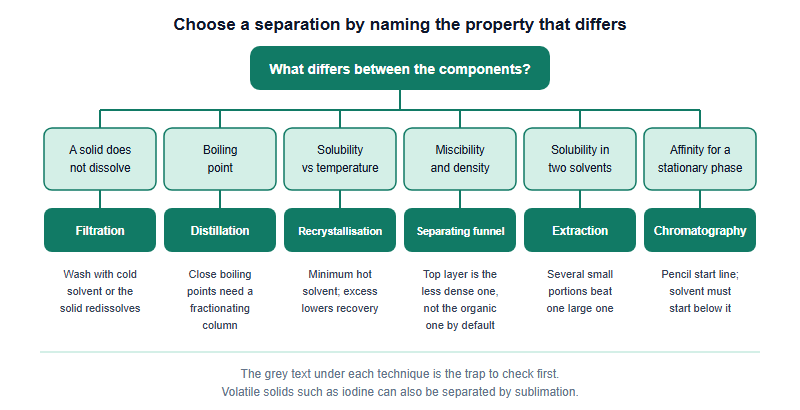
Two of these deserve numbers, because questions like to make them quantitative. Liquid–liquid extraction depends on the partition coefficient, K = [solute]organic/[solute]aqueous. Take a solute with K = 4 dissolved in 100 mL of water. One extraction with 100 mL of organic solvent leaves 100/(100 + 4 × 100) = 20% behind, removing 80%. Two extractions with 50 mL each leave 100/(100 + 4 × 50) = one-third behind each time, so one-ninth overall, removing about 89%. Several small portions beat one large one, and the gain comes from repeating the equilibrium, not from using more solvent.
Acid–base extraction adds a chemical step. Shake a mixture of benzoic acid and naphthalene in ether with aqueous sodium hydroxide, and the acid moves into the water layer as benzoate while naphthalene stays in the ether. Separate the layers, acidify the aqueous one, and benzoic acid precipitates. Which layer sits on top depends on density, not on which solvent is organic: diethyl ether floats on water, while dichloromethane sinks.
Chromatography questions turn on the retention factor, Rf = distance moved by the spot ÷ distance moved by the solvent front, both measured from the starting line. It is always less than 1, and it only identifies a substance when the stationary phase, solvent and conditions match. The starting line is drawn in pencil because ink would run, and the solvent must start below it, or the spots dissolve into the reservoir.
Which way does the error go? A three-step method
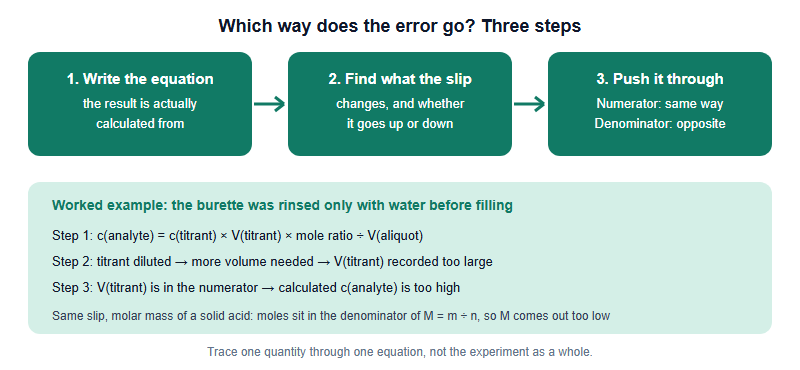
Error-direction questions ask whether a slip makes a calculated result too high, too low or leaves it unchanged. In our teaching team’s experience, students from lab-light courses lose these marks by imagining the experiment “going wrong” in general, when the question wants one quantity traced through one equation. The method has three steps: write the equation the result is actually calculated from; identify which measured quantity the slip changes, and in which direction; then see whether that quantity sits in the numerator or the denominator.
| Slip | Quantity it changes | Result | Direction |
|---|---|---|---|
| Burette rinsed only with water before filling with titrant | Titrant diluted, so a larger volume is recorded | Concentration of analyte | Too high |
| Pipette rinsed only with water before taking the aliquot | Fewer moles of analyte delivered, so less titrant is needed | Concentration of analyte | Too low |
| Distilled water already in the conical flask | Nothing that enters the calculation | Concentration of analyte | Unchanged |
| Air bubble in the burette tip that clears during the titration | Recorded volume larger than the liquid delivered | Concentration of analyte | Too high |
| Endpoint overshot | Titrant volume too large | Concentration of analyte | Too high |
| Hydrate not heated to constant mass | Mass lost too small | Percentage of water | Too low |
| Anhydrous residue left to cool uncovered | Water reabsorbed, so mass lost too small | Percentage of water | Too low |
| Solid spatters out of the crucible while heating | Mass lost too large | Percentage of water | Too high |
| Precipitate weighed while still damp | Precipitate mass too large | Percentage of analyte by gravimetry | Too high |
That last caveat is where good students still slip. Suppose the burette was rinsed only with water, but the question asks for the molar mass of a solid acid titrated with sodium hydroxide. The recorded titrant volume is still too large, so the calculated moles of acid are too large, and because molar mass is mass divided by moles, the molar mass comes out too low. The slip is identical; its place in the equation reverses the answer.
Drilling lab decisions at a desk, and who can sit the papers
You cannot build practical technique at a desk, but you can build the decisions, and a small weekly routine does it:
- Slip cards. Write five procedural slips a week, predict the direction for each, then check by writing the equation. Mix titration, gravimetric and gas-collection examples so that the equation keeps changing.
- Property first. For eight mixtures, write the differing property before naming a technique.
- One real measurement. If your school laboratory allows it, run one titration and record every burette reading to two decimal places. Seeing the spread across three titres teaches precision faster than any table.
- Past-paper questions. Work the descriptive and laboratory questions from our gathered pack of past papers, which runs from 1999 to 2025 with worked solutions for some years and not others; you can request it through this site.
Whether you will ever meet the practical depends on citizenship and enrolment rather than ability. A student without US citizenship or permanent residency who is enrolled at a US high school may sit the Local Exam, which has no practical, and cannot be nominated for the National Exam. A US citizen or permanent resident at an accredited American-curriculum school abroad, including in mainland China, who has been there a year and is under 20, can run the full route through an ACS International Chemical Sciences Chapter. A student on a Chinese passport at a mainland-China school has no ACS entry route, which makes the written laboratory reasoning in this guide one of the parts of the syllabus they can still train fully. Our eligibility guide sets out all three cases.
Frequently asked questions
Why rinse a burette with titrant but a conical flask with water?
Water left in a burette dilutes the titrant and changes the volume recorded. Water in the flask adds no moles of analyte, so it does not matter.
Is one large extraction or several small ones better?
Several small ones. With a partition coefficient of 4, two 50 mL portions remove about 89% of the solute; one 100 mL portion removes 80%.
When is heating to constant mass finished?
When two consecutive weighings, each taken after cooling, agree within the balance’s precision. One lower reading only shows mass is still being lost.
Does the Local Section Exam include a laboratory practical?
No. ACS lists it as 60 multiple-choice questions in 110 minutes. The laboratory practicals are Part III of the National Exam.
This is the USNCO information desk, synchronising official ACS information for chemistry students in China, operated by Hanlin Education. The USNCO is run by the American Chemical Society (ACS), which sets all official rules and eligibility; always confirm current details on acs.org. Anything we get wrong here is corrected within 7 working days of being reported.