
Beyond the gas laws, phase-change questions on USNCO papers ask you to do three things: read a phase diagram, reason about vapour pressure and boiling, and keep the energy books on a heating curve. They are one idea seen from three angles, because a phase change is an equilibrium. This guide works each angle with numbers you can check, and names the traps that cost marks.
Where phase changes turn up, and why they are one topic
Gases take most of the revision time in states of matter, but they are not the whole of it. On the 2025 Local Section Exam, which we worked through question by question, the paper ran in topic order and phase-change ideas appeared in two neighbouring runs. The states-of-matter questions went past the gas laws into a question that turned on where carbon dioxide’s critical point sits, a boiling-point comparison decided by intermolecular forces, and a close-packed solid. The thermodynamics questions that followed included a melting point calculated from an enthalpy and an entropy of fusion, and a heat balance that hinged on whether a melting could go to completion. None of these needs chemistry beyond a strong school course. All of them need the connections drawn cleanly.
Those connections come down to three statements worth writing at the top of your notes. At a transition temperature the two phases are in equilibrium, so ΔG = 0 and T = ΔH/ΔS. Vapour pressure is the equilibrium constant for vaporisation written as a pressure, so for a pure liquid it depends on temperature, not on how much liquid there is. And while a phase change is under way the temperature does not move, so every joule goes into the change rather than into warming. If you are new to how the paper is built, start with what the USNCO is.
Reading a phase diagram: five landmarks
A phase diagram plots pressure against temperature and draws the lines along which two phases coexist. Most questions can be answered from five landmarks, and water and carbon dioxide between them show every awkward case.
| Landmark | What it means | Water | Carbon dioxide |
|---|---|---|---|
| Triple point | The single temperature and pressure at which solid, liquid and gas coexist | 0.01 °C, 0.006 atm | −56.6 °C, 5.11 atm |
| Critical point | The end of the liquid–gas line; above both its temperature and its pressure, liquid and gas are no longer distinct | 374 °C, 218 atm | 31.0 °C, 72.8 atm |
| Normal melting point | Where the solid–liquid line crosses 1 atm | 0 °C | None: at 1 atm there is no liquid region to cross |
| Normal boiling or sublimation point | Where the liquid–gas line, or the solid–gas line, crosses 1 atm | Boils at 100 °C | Sublimes at −78.5 °C |
| Slope of the solid–liquid line | Its sign follows which of the two phases is denser | Negative: ice is less dense than liquid water | Positive: solid carbon dioxide is denser than the liquid |
Three reading habits prevent most errors:
- A supercritical fluid needs both conditions. Above the critical temperature but below the critical pressure, the substance is a gas. Below the critical temperature, above the melting temperature and at a pressure above the liquid–gas line, it is a liquid, however close to the critical point you are.
- The triple point is not a melting point. For carbon dioxide the triple-point pressure is above 1 atm, which is exactly why dry ice sublimes on a bench instead of melting.
- Pressure favours the denser phase. Squeeze ice and Le Chatelier’s principle pushes it towards the denser liquid, so its melting point falls as pressure rises and the solid–liquid line leans backwards. Most substances lean the other way. The Clapeyron equation, dP/dT = ΔH/(TΔV), says the same thing: the sign of the slope is the sign of the volume change.
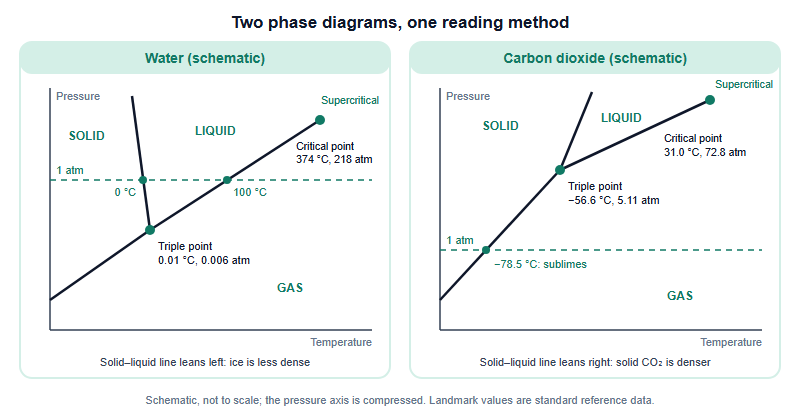
In our teaching team’s experience, the commonest phase-diagram slip is answering from the wrong landmark: quoting a triple point when the question is about 1 atm, or reading “near the critical point” as “supercritical”. Before looking at the options, write down which landmark the question is about.
Vapour pressure and boiling: an equilibrium constant in disguise
In a sealed container, molecules leave a liquid until evaporation and condensation balance, and the vapour’s pressure at that point is the vapour pressure. Because an equilibrium sets it, it depends on temperature, not on the amount of liquid or the container’s volume, provided some liquid remains. That last condition is a favourite trap: compress a container holding both liquid and vapour at constant temperature and the pressure does not rise; vapour simply condenses until the vapour pressure is restored.
A liquid boils when its vapour pressure reaches the external pressure, so at a lower external pressure it boils at a lower temperature. Stronger intermolecular forces mean a lower vapour pressure at a given temperature, a higher boiling point and a larger enthalpy of vaporisation.
The quantitative link is the Clausius–Clapeyron relation, ln P = −ΔHvap/(RT) + constant. The equation page of the 2025 Local Section Exam booklet printed ln K as a linear function of 1/T with slope −ΔH/R; vapour pressure is K for vaporisation, so that is the same relation. In two-point form:
ln(P2/P1) = −(ΔHvap/R)(1/T2 − 1/T1)
Worked example: at what temperature does water boil when the external pressure is 0.70 atm? Take ΔHvap = 40.7 kJ mol−1 and the normal boiling point, 373.15 K at 1.00 atm.
- ln(0.70/1.00) = −0.357
- ΔHvap/R = 40 700 J mol−1 ÷ 8.314 J mol−1 K−1 = 4895 K. Convert kilojoules to joules first; this is the unit slip that costs the mark.
- 1/T2 − 1/T1 = 0.357 ÷ 4895 = 7.29 × 10⁻⁵ K−1
- 1/T2 = 2.680 × 10⁻³ + 0.073 × 10−3 = 2.753 × 10⁻³ K−1, so T2 = 363 K, about 90 °C
That lands within about a degree of the measured boiling point of water at that pressure, which is good for a formula that treats ΔHvap as constant. Two checks catch almost every error here: a lower pressure must give a lower boiling point, and every temperature must be in kelvin before you take a reciprocal.
One shortcut earns its place. For many liquids without hydrogen bonding, ΔSvap at the normal boiling point is close to 85–88 J mol−1 K−1 (Trouton’s rule): benzene, with ΔHvap of about 30.7 kJ mol−1 at 353 K, gives 87. Water gives 109, well above the band, because hydrogen bonding orders the liquid. It is a quick sanity check on any value you calculate.
Heating curves, mixing problems and the ΔG = 0 condition
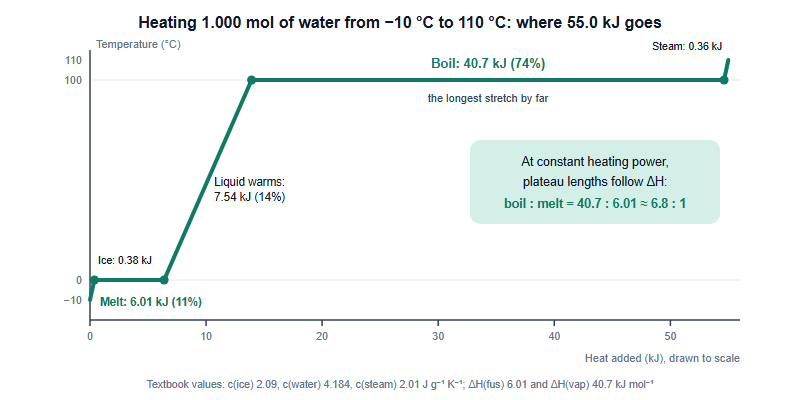
A heating curve plots temperature against heat added. Sloped sections are one phase warming, where q = mcΔT. Flat sections are a phase change, where q = nΔH and the temperature stays put until the change is complete. The table follows one mole of water from ice at −10.0 °C to steam at 110.0 °C using typical textbook values.
| Stage | Relation | Working | Heat (kJ) | Share of total |
|---|---|---|---|---|
| Ice warms, −10.0 to 0.0 °C | q = mcΔT | 18.02 g × 2.09 J g−1 K−1 × 10.0 K | 0.38 | 0.7% |
| Ice melts at 0 °C | q = nΔHfus | 1.000 mol × 6.01 kJ mol−1 | 6.01 | 10.9% |
| Water warms, 0.0 to 100.0 °C | q = mcΔT | 18.02 g × 4.184 J g−1 K−1 × 100.0 K | 7.54 | 13.7% |
| Water boils at 100 °C | q = nΔHvap | 1.000 mol × 40.7 kJ mol−1 | 40.70 | 74.0% |
| Steam warms, 100.0 to 110.0 °C | q = mcΔT | 18.02 g × 2.01 J g−1 K−1 × 10.0 K | 0.36 | 0.7% |
| Total | 54.99 | 100% |
The number that surprises students is the share: boiling takes about three-quarters of the total, more than five times the energy needed to warm the liquid from 0 °C to 100 °C. At constant heating power each plateau’s length is proportional to its enthalpy change, so for water the boiling plateau is about 6.8 times as long as the melting plateau. A question that shows a curve and asks for a ratio of enthalpies is asking you to measure two plateaus.
Mixing problems are the same bookkeeping with a decision in front of it: before you write “heat lost = heat gained”, check whether the phase change can finish. Add 10.0 g of ice at 0 °C to 50.0 g of water at 20.0 °C. Cooling the water to 0 °C releases 50.0 × 4.184 × 20.0 = 4184 J, and melting all the ice needs 10.0 × 333.5 = 3335 J, so all of it melts and the balance 4184 − 209.2T = 3335 + 41.84T gives 3.4 °C. Double the ice to 20.0 g and melting it all would need 6670 J, more than is available, so the mixture stops at 0 °C with about 12.5 g melted and 7.5 g of ice left. If an equation hands you liquid water below 0 °C, you skipped the check.
The same bookkeeping explains where transition temperatures come from. At the normal melting point solid and liquid coexist, so ΔG = ΔH − TΔS = 0 and T = ΔH/ΔS; for ice, 6010 J mol−1 ÷ 273.15 K gives ΔSfus = 22.0 J mol−1 K−1, and above that temperature TΔS outweighs ΔH, so melting is spontaneous. The traps are units. Enthalpies arrive in kJ mol−1 and entropies in J mol−1 K−1, so an unconverted division is a thousand times too small, and one of the classic wrong answers is the right number left in kelvin when the question wants degrees Celsius. Write the units into the division, and convert to Celsius only at the end.
Drilling it, and a note on who can sit the papers
This topic rewards short, exact practice. A routine our teaching team uses takes about thirty minutes a week:
- Sketch both phase diagrams from memory, marking the triple point, critical point and 1 atm line, then check them against the table.
- Work three two-point Clausius–Clapeyron problems, solving for a pressure, a temperature and ΔHvap, with units written in.
- Do one heating curve and one mixing problem, with the phase-change check as the first line.
- Finish with past-paper questions from the states-of-matter and thermodynamics runs. Our gathered pack of past papers runs from 1999 to 2025, with worked solutions for some years and not others, and you can request it through this site.
Before planning a season around the exam itself, check the access rules, because they depend on citizenship and enrolment rather than ability. A student without US citizenship or permanent residency who is enrolled at a US high school may sit the Local Exam but cannot be nominated for the National Exam. A US citizen or permanent resident at an accredited American-curriculum school abroad, including in mainland China, who has been there a year and is under 20, can run the full route through an ACS International Chemical Sciences Chapter. A student on a Chinese passport at a mainland-China school has no ACS entry route, and for that student the value is the chemistry itself. Our eligibility guide sets out all three cases.
Frequently asked questions
Does vapour pressure depend on how much liquid is in the container?
No. While some liquid remains, a pure liquid’s vapour pressure depends only on temperature, not on the amount of liquid or the container volume.
Why does the solid–liquid line for water slope backwards?
Ice is less dense than liquid water, so higher pressure favours the liquid and lowers the melting point. Most substances slope the other way.
Is the Clausius–Clapeyron equation given on the exam?
The 2025 Local Section Exam booklet printed ln K against 1/T. Vapour pressure is K for vaporisation, so it is the same relation. Check yours.
In a mixing problem, how do I know whether all the ice melts?
Compare the heat released cooling the warm sample to 0 °C with the heat needed to melt all the ice, before you write any heat balance.
This is the USNCO information desk, synchronising official ACS information for chemistry students in China, operated by Hanlin Education. The USNCO is run by the American Chemical Society (ACS), which sets all official rules and eligibility; always confirm current details on acs.org. Anything we get wrong here is corrected within 7 working days of being reported.