To prepare for the U.S. National Chemistry Olympiad (USNCO), work backwards from the April National Exam over several months: map the full ACS syllabus, then work years of past papers (1999–2025) under timed conditions, drilling the free-response paper and the laboratory practical specifically — not just multiple choice. Depth beats cramming, and starting early is the single biggest lever.
Start from the exam you are preparing for
A study plan only works if it is anchored to the real exam structure. The USNCO is run by the American Chemical Society (ACS), and its decisive stage — the National Exam in April — has three parts that test very different skills. Most students over-prepare for the multiple-choice paper, which they have seen in school, and under-prepare for the written free-response paper and the hands-on lab. A good roadmap rebalances that. For the full breakdown, see Inside the USNCO National Exam.
| Part of the National Exam | What it tests | How to train it |
| Multiple choice — 60 questions, 90 min | Breadth and speed across the syllabus | Timed past-paper sets; track which topics you miss |
| Free response — written, 105 min | Worked solutions, mechanisms, full reasoning shown | Write out solutions by hand; mark against answer keys |
| Laboratory practical — 90 min | Bench technique, measurement, procedure | Real lab time; titration, gravimetric & observational skills |
Timings and format are set by ACS and can change — confirm current details on the official ACS channels before you plan around them.
Step one: map the full syllabus before you drill
Before working a single past paper, map the entire ACS syllabus end to end so you know the territory and can spot your own gaps. The USNCO covers the standard pillars of general and introductory advanced chemistry — and the free-response and lab sections reward genuine understanding, not memorised facts. A realistic syllabus map for most students includes:
- Stoichiometry and the mole concept — limiting reagents, percent yield, empirical formulae
- Thermodynamics — enthalpy, entropy, free energy, Hess’s law
- Chemical equilibrium — Kc/Kp, Le Chatelier, solubility products
- Acids, bases and buffers — pH, titration curves, polyprotic systems
- Kinetics — rate laws, mechanisms, Arrhenius behaviour
- Electrochemistry — cells, the Nernst equation, electrolysis
- Atomic and molecular structure — periodicity, bonding, VSEPR
- Organic chemistry — functional groups, reactions and mechanisms
Treat this map as a checklist. The goal of the first phase is simple: never be surprised by a topic in a past paper, only by the difficulty of a question. For the full scope, read The USNCO Syllabus: What Chemistry It Actually Covers.
Step two: work years of past papers — the right way
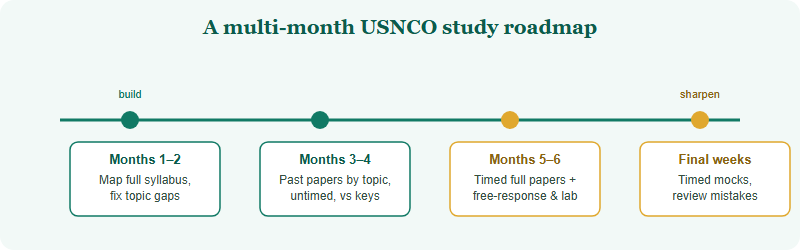
The USNCO publishes its past papers from 1999 to 2025 with answer keys, and they are the single most valuable preparation resource available — rigorous, well-structured, and free to study. But how you use them matters more than how many you do. The progression that works:
- Phase A — by topic, untimed. Pull questions on one theme (say, equilibrium) across many years. Work them slowly, check every answer against the key, and rebuild any topic where you are weak.
- Phase B — full papers, untimed. Sit a whole paper without the clock, then mark it honestly and log every error in a single notebook by category, not by paper.
- Phase C — full papers, strictly timed. Replicate exam conditions: 90 minutes for the 60 multiple-choice questions, 105 for the free response. This is where speed and stamina are built.
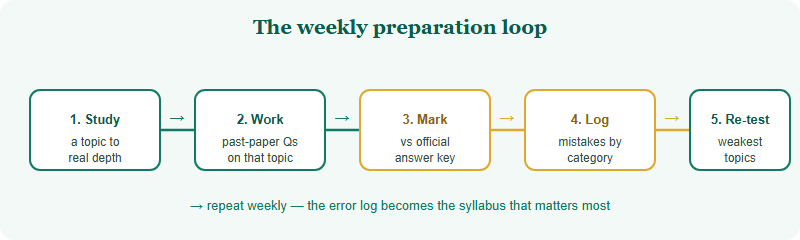
- Phase D — review the error log. Your mistake notebook becomes the syllabus that matters most. Re-test the categories you keep missing until they stop appearing.
Do not paste or memorise specific paper questions — the papers are copyrighted by ACS, and rote recall does not transfer. The skill you are building is method: recognising question types and reaching a correct, fully-worked solution under time. Our guide on how to use the USNCO past papers walks through this in detail.
A realistic cadence for the past-paper phase is roughly one to two papers a week, paired with focused topic review in between — enough to compound steadily without burning out before April. With papers spanning 1999 to 2025, there is no shortage of material: prioritise the most recent decade for current syllabus emphasis, then reach back to older years for extra breadth. Keep the marking honest. The temptation is to read the answer key and nod along; the discipline is to score yourself as a marker would, awarding nothing for reasoning you only held in your head. It also helps to know what “good” looks like at the National level: the top 50 students nationally earn High Honors, and the next 100 earn Honors. You are not chasing a pass mark — you are building the depth and accuracy that those tiers reward.
Step three: drill the free-response paper and the lab specifically
This is where most preparation falls short. The multiple-choice paper is the part students already know how to study; the free-response paper and the laboratory practical are where strong candidates separate themselves.
For the free response, practise writing complete solutions by hand — showing every step, every unit, and the reasoning a marker needs to award full credit. Mark your work against the official answer keys and ask, each time: would this earn the marks, or did I leave the reasoning in my head? Partial credit is real, so never leave a question blank.
For the laboratory practical, you need genuine bench time. Titration accuracy, gravimetric technique, careful observation and clean procedure are skills of the hands, not the textbook — they cannot be revised on paper. If you have access to a school or program lab, schedule real practice into the roadmap. If you do not, the rest of the plan still builds deep chemistry, but the lab is the part that most rewards hands-on practice.
Start early — and a note for students in China
The students who reach the National Exam and beyond do not improvise; they start months ahead and let depth accumulate. Roughly 10,000 students sit the Local Exam each year, more than 1,000 advance to the National Exam, the top 20 are invited to the residential Study Camp at the University of Maryland, and four are chosen as Team USA for the International Chemistry Olympiad. In 2025, Team USA won four gold medals at the IChO in Dubai. None of that comes from a final-week push.
A word of honesty for international readers. The USNCO is for U.S. high-school students, who enter through an ACS Local Section — there is no individual sign-up from abroad, and eligibility is set entirely by ACS. If you are a student in China, do not assume you can register for or compete in the USNCO directly; confirm any participation question on the official ACS channels. What you can do — and what is genuinely valuable — is treat this roadmap as a chemistry-mastery program: the public syllabus and the 1999–2025 past papers are among the best competition-chemistry materials anywhere, and working them to depth builds real skill whether or not you ever sit the exam. To understand the full system first, read What Is the USNCO.
Frequently asked questions
How early should I start preparing for the USNCO?
Several months ahead. A depth-first plan — map the syllabus, then work years of past papers under timed conditions — beats cramming. Starting early is the single biggest lever on your score.
What is the best way to use USNCO past papers?
Work them by topic and untimed first, checking every answer against the official key; then sit full papers under strict time. Log mistakes by category and re-test the weakest ones.
How do I prepare for the free-response and lab parts?
Write full solutions by hand and mark them against the answer keys; for the lab, get genuine bench time — titration and gravimetric technique can’t be revised on paper.
Can a student in China prepare for the USNCO?
You can use the public syllabus and 1999–2025 past papers as a chemistry-mastery program. But the USNCO is for U.S. high-school students via an ACS Local Section — confirm eligibility on the official ACS channels.
This is the U.S. National Chemistry Olympiad (USNCO) information desk, synchronising the official competition information — dates, rules, the syllabus, past papers and results — for chemistry students in China, operated by Hanlin Education. The USNCO is run by the American Chemical Society (ACS), which sets all official rules and eligibility; the information here is synced from official ACS sources. Always confirm current details on acs.org. Confirmed errors are corrected within 7 working days.