Honestly: it depends which of three situations you are in. If you are a student at a school in mainland China without U.S. citizenship or a green card, then no — there is no ACS route for you, and we will not pretend otherwise. But two other groups do have one: a non-U.S. national at a high school in the United States may sit the Local Exam (never the National Exam), and a U.S. citizen or green-card holder at an accredited American school abroad — including in China — has the full route to Team USA through an ACS International Chemical Sciences Chapter. Eligibility is set by the American Chemical Society; confirm it on the official ACS channels. And the genuinely useful part — the public past papers (1999–2025) and syllabus — is open to everyone, whichever case you are in.
The short, honest answer
It is easy to assume that a major U.S. competition either has an open online entry form for anyone in the world, or is flatly closed to everyone outside America. Neither is true. The USNCO exists to select Team USA for the International Chemistry Olympiad, so its rules are built around nationality and school accreditation rather than around geography — which is why “can I take it from China?” has three different answers depending on who is asking. We say this plainly because a vague answer would waste your time, and because the blanket “no” you will see repeated online is wrong for two real groups of students. What follows is the actual picture: how entry works, which case you are in, and the part that is open to you regardless.
| Case 1 — a non-U.S. national at a high school in the United States | May sit the Local Exam through that school’s ACS Local Section. Cannot be nominated for the National Exam, whatever the score |
| Case 2 — a U.S. citizen or green-card holder at an accredited American school abroad (this includes China) | The full route. Local and national competition organised by an ACS International Chemical Sciences Chapter; National Exam, Study Camp and Team USA all reachable. Must be enrolled at least one year and under 20 |
| Case 3 — not a U.S. citizen or green-card holder, at a school in mainland China | No ACS route. This is most of our readers, and we say so plainly rather than leaving you hoping |
| Is there a form I can fill in myself? | No. Entry is always mediated by an ACS Local Section or International Chapter, never an individual sign-up from abroad — but that describes the mechanism, not whether a route exists |
| Who sets eligibility? | ACS (American Chemical Society) and its sections and chapters — rules can change each year |
| What is open to everyone? | The public past papers (1999–2025) with answer keys and the published syllabus |
| Is that worth it? | Yes — it is among the best chemistry-olympiad practice in the world, exam or no exam |
Eligibility, dates and rules are set by ACS and can change each year. Always confirm current details on the official ACS channels before planning around them.
How USNCO entry actually works
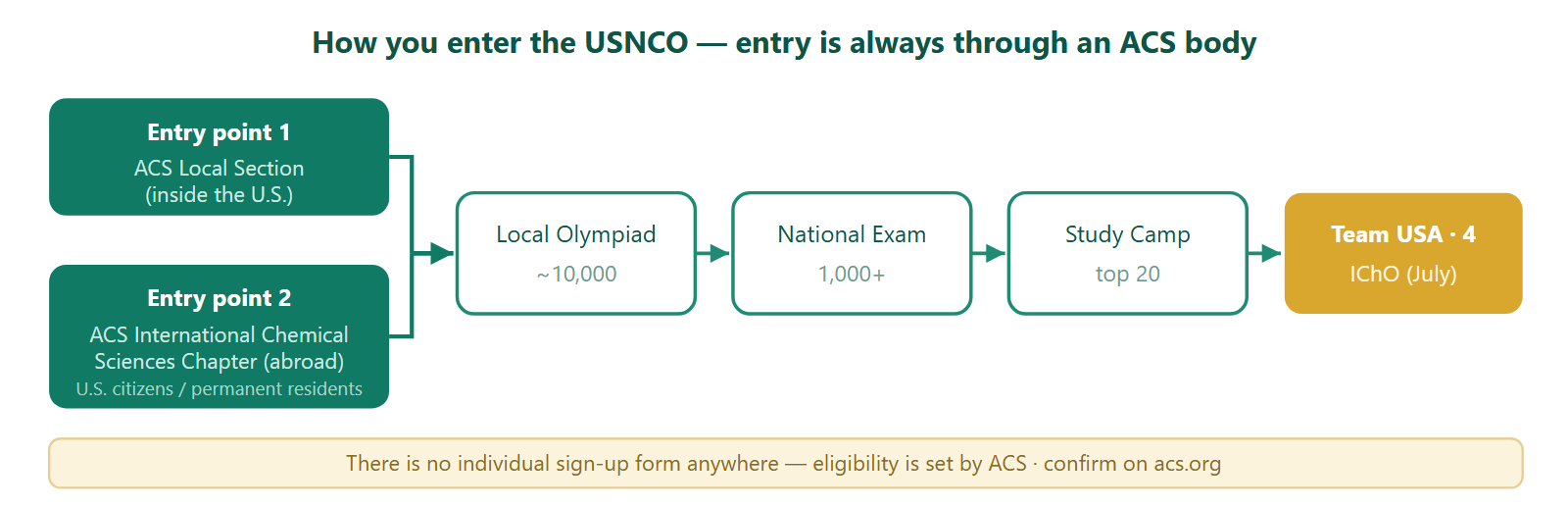
Understanding the route makes the eligibility answer far clearer. The USNCO is a single competition run in four tiers, and the very first tier is the gate. You do not register with ACS on a national website; you sit the Local Chemistry Olympiad through your ACS Local Section — a regional ACS body tied to schools and educators — or, if you are abroad and eligible, through an ACS International Chemical Sciences Chapter, which organises its own local and national competition. Roughly 10,000 students sit that Local Exam (27 Feb–16 Mar), more than 1,000 advance to the National Chemistry Olympiad (10–19 Apr), the top 20 are invited to a residential Study Camp at the University of Maryland (31 May–13 Jun), and four are chosen as Team USA for the International Chemistry Olympiad (10–19 Jul). So the on-ramp is always a section or a chapter, never an individual application form — but an on-ramp abroad does exist, for students who meet ACS’s conditions. For the full structure, see What Is the USNCO and The Local Chemistry Olympiad: The First Tier, Explained.
The three cases, in ACS’s own words
Eligibility only becomes clear once you separate three situations that get blurred together. ACS’s published rules and its coordinator’s handbook set out each one, so here they are in ACS’s language rather than ours.
Case 1 — you are not a U.S. national, but you attend a high school in the United States
You may sit the Local Exam. The handbook’s local-level requirement contains no citizenship condition at all: “All interested secondary school students (grades 9-12) who can be accommodated by their local section are invited to participate in the local section selections and Local Section Exam (LSE).” What you cannot do is go further. ACS is explicit: “Students must be U.S. citizens or legal, permanent residents of the United States (green card holders) to take the National Exam. Students who do not meet the citizenship criteria can only participate in the Local Exam without the possibility of being nominated to sit for the National Exam, regardless of their performance (score).” That rule is hard and it is enforced — students sign a statement about their legal status at registration, and exams cannot be accepted without it.
Case 2 — you hold U.S. citizenship or a green card and attend an accredited American school abroad
You have the full route, and it can run from inside China. Under ACS’s heading for U.S. citizens living abroad: “A local and national competition must be organized by an ACS International Chemical Sciences Chapter.” The conditions are specific: “Eligible high school (9-12th grade) students must be U.S. citizens or legal, permanent residents of the United States (green card holders), presently enrolled in an American school* for at least one year, and under the age of 20.” ACS defines that asterisk as a school accredited by MSACS, WASC, SACS, NEASC, NCASC or NACS. This is not theoretical: ACS’s published top-20 list and its C&EN Study Camp report name students at a school in Shanghai competing through the Shanghai International Sciences Chapter — one of whom was named to Team USA for the 2026 IChO.
Case 3 — you are not a U.S. citizen or green-card holder, at a school in mainland China
There is no ACS route, and this describes most of our readers. The provision for students abroad requires U.S. citizenship or permanent residency, and a further ACS rule confines every entrant to a single section: “A student may participate only in the competition of the section in which the student’s high school is located.” Together those close the door. Two cautions follow from it:
- Be careful with anyone promising “USNCO registration” from China. There is no ACS “China region” of the USNCO open to non-U.S.-national students. Whatever parallel administration you may have seen referenced a few years ago was not an ACS Local Section and is not running; verify any claim against acs.org.
- Do not expect extra award tiers. ACS recognition is High Honors (top 50) and Honors (next 100) — nothing else. Any additional “regional” medal scheme is not an ACS distinction.
It also helps to know why the rules are shaped this way. The USNCO is, by design, a national-team selection process: ACS established it in 1984 to identify the strongest U.S. high-school chemists and develop four of them to world standard for the IChO each July. That is why the tests are of nationality and school accreditation rather than of postcode — a U.S. passport holder at an accredited American school in Shanghai is part of the talent pool ACS is selecting from, while a student at a Chinese national curriculum school, however strong, is not. So the closed door in Case 3 is not an oversight; it follows directly from what the competition is for. In 2025, that pipeline sent a Team USA that won four gold medals at the IChO in Dubai.
None of this is meant to be discouraging. If you are in Case 1 or Case 2, the point is that you should stop reading the internet’s blanket “no” and go and check your own eligibility with ACS. If you are in Case 3, the point is to save you from building a plan on a door that is not open — because the most valuable thing the USNCO produces is something you can use today, whichever case you are in.
The part that is genuinely open to you: the past papers
Here is the generous, true answer. The USNCO’s past papers from 1999 to 2025 come with answer keys, and its syllabus is published. These materials are open to any student anywhere, and they are among the best chemistry-olympiad preparation resources in the world — rigorous, well-structured, and free to study. For a chemistry student in China aiming at top university chemistry, that library is a serious asset whether or not you ever sit the official exam.
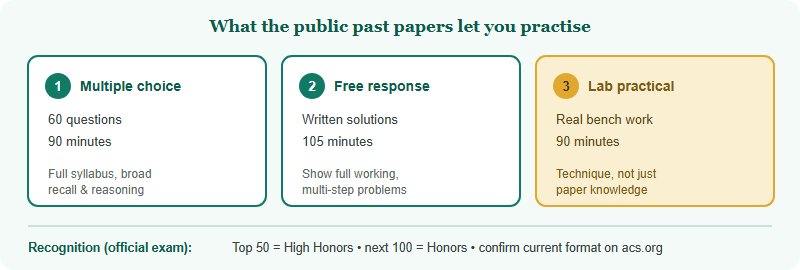
What makes them so good is the range. The National Exam is built from three very different parts — a 60-question multiple-choice paper (90 minutes), a written free-response paper (105 minutes), and a laboratory practical (90 minutes) — and the released papers let you train each one deliberately rather than only drilling multiple choice. That breadth matters: most school chemistry rewards recall, but the free-response sections demand sustained multi-step reasoning, and the lab-style questions reward thinking like a chemist at the bench. Working through the library under timed conditions is, in itself, a structured route to real depth in competition chemistry — and it maps onto exactly the skills that top university chemistry programmes look for.
How to use the past papers well (from anywhere)
Strong competition chemistry is built, not improvised — and the same routine works whether or not you ever sit the official exam. We do not reproduce the copyrighted paper text here; instead, here is how serious students use the public library:
- Map the syllabus first. Use the published USNCO syllabus as your checklist before touching a single paper, so you know what “complete” looks like.
- Work years of papers under timed conditions. The 1999–2025 range lets you build a genuine exam rhythm rather than cramming facts.
- Practise the written and lab thinking, not only multiple choice. The free-response sections are where depth is proven; the lab-style questions train how a chemist reasons at the bench.
- Mark honestly with the answer keys. The released keys let you self-assess and target weak topics with discipline.
For a step-by-step routine built around the released library, see USNCO Past Papers (1999–2025): How to Use Them to Prepare. Used this way, the papers are a structured, rigorous path to a high standard in chemistry — which is the real prize for a student in China, regardless of who is eligible to sit the exam.
Frequently asked questions
Can a student in China take the USNCO?
It depends on nationality and school. If you are a U.S. citizen or green-card holder enrolled for at least a year at an accredited American school in China and under 20, ACS provides a route through an ACS International Chemical Sciences Chapter, which organises its own local and national competition. If you are not a U.S. citizen or permanent resident, there is no ACS route. Eligibility is set by ACS — confirm on the official ACS channels.
I am not a U.S. national but I attend a high school in the United States. Can I compete?
You may sit the Local Exam through your school’s ACS Local Section — the ACS coordinator handbook invites all interested secondary students (grades 9-12) who can be accommodated by their local section, with no citizenship condition at that level. You cannot be nominated for the National Exam: ACS states that students who do not meet the citizenship criteria may participate in the Local Exam only, with no possibility of nomination, regardless of their score. That rule is enforced by a signed legal-status statement at registration.
Is there a USNCO China region I can register for?
No. There is no ACS China region open to non-U.S.-national students, and ACS recognition is High Honors and Honors only. The one ACS route inside China runs through an International Chemical Sciences Chapter and requires U.S. citizenship or a green card plus an accredited American school. Treat any other “USNCO registration” offer with caution and verify against acs.org.
Is it true there is no online entry form for overseas students?
Yes — but that is a statement about the mechanism, not about whether a route exists. Entry is always mediated by an ACS Local Section or an ACS International Chemical Sciences Chapter, never an individual sign-up form.
Can international students still benefit from the USNCO?
Yes. The 1999–2025 past papers and the syllabus are public and free to study — among the best chemistry-olympiad practice anywhere, useful whether or not you are eligible to sit the exam.
This is the U.S. National Chemistry Olympiad (USNCO) information desk, synchronising the official competition information — dates, rules, the syllabus, past papers and results — for chemistry students in China, operated by Hanlin Education. The USNCO is run by the American Chemical Society (ACS), which sets all official rules and eligibility; the information here is synced from official ACS sources. Always confirm current details on acs.org. Confirmed errors are corrected within 7 working days.