The USNCO Study Camp is a two-week residential training programme held each June at the University of Maryland for the top 20 scorers on the National Chemistry Olympiad exam. Over roughly 31 May–13 Jun 2026, these students sit through intensive lectures, written tests and full laboratory practicals. From their performance at camp, the American Chemical Society (ACS) selects the four-student Team USA that competes at the International Chemistry Olympiad (IChO) in July.
Quick facts: the Study Camp (2026)
| What it is | A residential training camp where Team USA is selected for the International Chemistry Olympiad |
| Who attends | The top 20 students from the National Chemistry Olympiad exam |
| Where | University of Maryland, College Park |
| When (2026) | 31 May – 13 Jun (roughly two weeks) |
| What happens | University-level lectures, written theory exams and full laboratory practicals |
| Outcome | Four students chosen as Team USA; the rest finish as national finalists |
| Next stop | International Chemistry Olympiad, 10–19 Jul 2026 |
Dates, the camp format and selection rules are set by ACS and can change each year — always confirm current details on the official ACS channels before you plan around them.
Where the Study Camp sits in the USNCO pathway
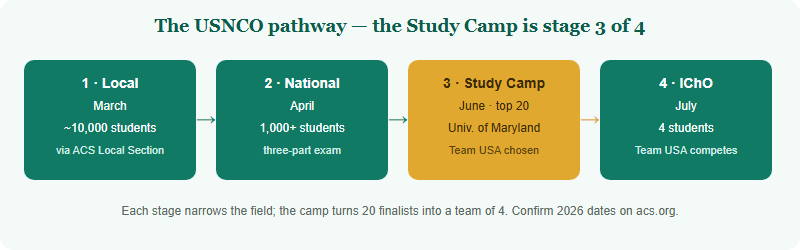
The Study Camp is the third of four stages in the U.S. National Chemistry Olympiad, which the American Chemical Society has run since 1984. Each year roughly 10,000 students sit the Local Chemistry Olympiad in March through their ACS Local Section; more than 1,000 advance to the National Chemistry Olympiad exam in April; the top 20 are invited to the Study Camp in June; and four are named to Team USA for the IChO in July. The camp is the final filter — the point where a national field of strong chemists becomes a team of four.
How students reach the camp: the National Exam
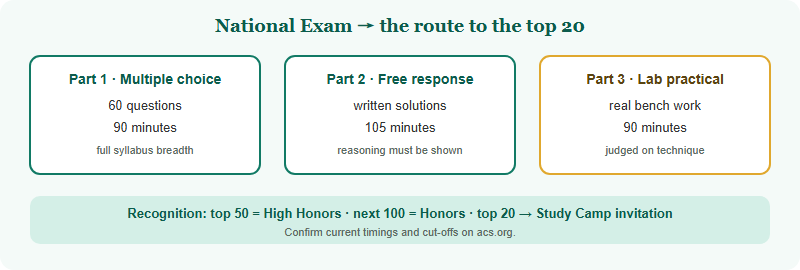
The 20 students who attend the Study Camp earn their place on a single, demanding exam — the National Chemistry Olympiad, held over 10–19 Apr 2026. It is built from three parts that test very different skills, and it is the third part that makes the USNCO distinctive among chemistry competitions: a genuine laboratory practical, judged on bench technique rather than paper knowledge.
- Multiple choice — 60 questions in 90 minutes, spanning the full chemistry syllabus.
- Free response — a written paper of worked solutions, 105 minutes, where reasoning must be shown.
- Laboratory practical — 90 minutes of real bench work, assessed on technique and accuracy.
Nationally, the top 50 students earn High Honors and the next 100 earn Honors. The very top of that field — the leading 20 — receive the camp invitation. Understanding this structure is the single most useful thing a student can do before building a serious study plan, because the camp rewards exactly the breadth and lab fluency the National Exam already demands.
What happens during the two weeks
The Study Camp is best understood as a compressed, university-level chemistry course combined with a continuous assessment. For roughly two weeks at the University of Maryland, the 20 finalists live and work together, taught by college faculty and experienced mentors. The days are full and deliberately demanding — the goal is both to raise everyone to international standard and to find out who performs under that pressure.
While the exact daily schedule is set by ACS each year and should be confirmed on the official channels, the camp is consistently built around the same elements:
- Advanced lectures covering topics well beyond a standard high-school course — moving toward the depth expected at the IChO.
- Written theory examinations taken throughout the camp, modelled on international-standard problems.
- Full laboratory practicals, where students run real experiments and are assessed on technique, accuracy and safety.
- Mentoring and feedback from faculty and former olympians, sharpening both knowledge and exam craft.
Because the IChO itself is split between a theory paper and a long laboratory examination, the camp gives both equal weight. A student who is brilliant on paper but uncertain at the bench, or vice versa, finds that gap exposed quickly. That balance — and the published USNCO past papers that prepare students for it — is explored further in our USNCO study roadmap.
How the four-student Team USA is chosen
Selection is performance-based and happens at the camp, not before it. The 20 finalists are continuously assessed across the camp’s written theory tests and laboratory examinations, and the four students with the strongest combined results are named to Team USA. The remaining 16 finish as national finalists — an achievement in itself, placing them among the most accomplished high-school chemists in the country that year.
The four who are selected go on to represent the United States at the International Chemistry Olympiad in July. A look at what that level of result signals — and why it matters for university admissions — is covered in what Team USA results signal. In 2025, the U.S. team won four gold medals at the IChO in Dubai, the strongest possible result and a measure of how effectively the camp prepares its finalists. The exact criteria and weighting ACS applies can vary year to year, so confirm specifics on the official ACS channels.
| Stage | Who is involved | What is being decided |
| Arrive at camp | Top 20 National Exam scorers | Nothing yet — all 20 are finalists |
| Two weeks of assessment | The 20 finalists | Theory exams + lab practicals scored throughout |
| Team selection | ACS, on camp results | The four strongest become Team USA |
| IChO in July | Team USA (4 students) | International medals |
What this means for chemistry students in China
It is worth being precise here, because the usual shorthand — “the USNCO is for American students” — is wrong in both directions. ACS sets eligibility on citizenship and school, not on which country a student is sitting in. Three cases cover almost every reader:
- A non-U.S. national at a high school in the United States — may sit the Local exam through that school’s ACS Local Section, but ACS states that such a student “can only participate in the Local Exam without the possibility of being nominated to sit for the National Exam, regardless of their performance (score)”. The camp, which follows the National Exam, is therefore out of reach.
- A U.S. citizen or permanent resident (green-card holder) at an accredited American school abroad — including American and international schools in China — has the full route, provided they have been enrolled for at least a year and are under 20. ACS requires the local and national competition to be organised by an ACS International Chemical Sciences Chapter. This is not theoretical: ACS’s own published lists include students from Shanghai High School International Division entering through the Shanghai International Sciences Chapter, and one of them reached the 2026 Study Camp and was named to Team USA.
- A student who is not a U.S. citizen or permanent resident, at a school in mainland China — has no ACS route. The overseas provision requires U.S. citizenship or permanent residency, and ACS confines a student to the section where their school is located. For most readers of this site, that is the honest answer.
In none of these cases is there an individual sign-up from abroad: entry always runs through a coordinator at an ACS Local Section or International Chapter, never a form a student submits alone. That describes the mechanism, not whether a route exists. Because all of this is ACS’s to set and revise, confirm your own position on the official ACS channels — and see our fuller treatment in who can actually enter the USNCO.
For a student in that third group, the genuine value of the USNCO system is twofold. First, understanding how the pathway works — Local, National, Study Camp, IChO — clarifies what world-class competition chemistry actually demands. Second, and more practically, the USNCO’s past papers (1999–2025) and published syllabus are among the best chemistry-olympiad practice materials anywhere. Worked through under timed conditions — multiple choice, free response and, where possible, the practical skills the camp prizes — they are a serious, structured way to build real chemistry depth, whatever competition you ultimately sit. Our study roadmap shows how to use them well.
Frequently asked questions
What is the USNCO Study Camp?
A two-week residential training camp at the University of Maryland for the top 20 National Exam scorers, where the four-student Team USA is selected for the International Chemistry Olympiad.
How is Team USA chosen at the camp?
The 20 finalists are assessed on written theory exams and laboratory practicals throughout the camp; the four with the strongest combined results are named to Team USA. Confirm exact criteria on acs.org.
When and where is the 2026 Study Camp?
It runs roughly 31 May to 13 Jun 2026 at the University of Maryland, College Park, ahead of the International Chemistry Olympiad on 10–19 Jul. Confirm current dates on the official ACS channels.
Can a student in China attend the Study Camp?
Only a U.S. citizen or green-card holder at an accredited American school, entering through an ACS International Chemical Sciences Chapter — ACS’s own lists show such students from Shanghai reaching the camp. A student who is not a U.S. national or permanent resident has no ACS route; the public 1999–2025 past papers remain the real value. Confirm eligibility with ACS.
This is the U.S. National Chemistry Olympiad (USNCO) information desk, synchronising the official competition information — dates, rules, the syllabus, past papers and results — for chemistry students in China, operated by Hanlin Education. The USNCO is run by the American Chemical Society (ACS), which sets all official rules and eligibility; the information here is synced from official ACS sources. Always confirm current details on acs.org. Confirmed errors are corrected within 7 working days.