Is the U.S. National Chemistry Olympiad (USNCO) worth it? For the right student, yes — but as a signal of genuine chemistry depth, not a guaranteed credential. Run by the American Chemical Society (ACS) since 1984, the USNCO narrows roughly 10,000 students to a four-person Team USA, which won four gold medals at the International Chemistry Olympiad (IChO) 2025 in Dubai. For students in China, the value is mastery built through its public 1999–2025 past papers, not a route to enter.
What "worth it" actually means here
A competition is "worth it" when the effort you invest produces something durable. With the USNCO, that durable thing is twofold: a body of real chemistry mastery, and — for those eligible to sit the exam — a nationally calibrated signal of where you stand. Neither is a shortcut. The system is designed to be steep precisely so that the people who reach its upper tiers have demonstrably earned it. Understanding what each level of recognition signals is the first step to deciding whether the road is worth your time.
It helps to be clear about what the USNCO is before weighing its value. It is a four-tier selection competition — Local Chemistry Olympiad, National Chemistry Olympiad, Study Camp, and the IChO — run by ACS to choose the four students who represent the United States internationally. For the full structure, see our companion explainer, What Is the USNCO. This article focuses on a narrower question: given that structure and the 2025 results, what does reaching each stage genuinely signal, and how should a student in China think about the value?
What the 2025 Team USA result signals
At IChO 2025 in Dubai, all four members of Team USA won gold medals. That is a notable outcome, and it is worth reading carefully rather than as marketing. A clean sweep of gold at the international level signals two things. First, the four-tier selection funnel works as intended: filtering 10,000 entrants down to four through a Local exam, a rigorous three-part National exam, and a two-week residential Study Camp reliably surfaces students of exceptional depth. Second, it sets a reference point for the standard at the very top of the system — the level the syllabus and past papers are calibrated to produce.
What it does not signal is that USNCO participation guarantees a similar result, an award, or any specific admissions outcome for an individual. Team USA is exactly four students per year, chosen from the strongest performers in the country after months of escalating selection. The honest framing is that the 2025 gold sweep shows what the pinnacle of the pathway looks like — a benchmark to learn from — not a result that transfers to anyone who engages with the material. The road from a strong local score to an IChO medal is long, and most able students never travel its full length.
High Honors and Honors: what the recognition bands mean
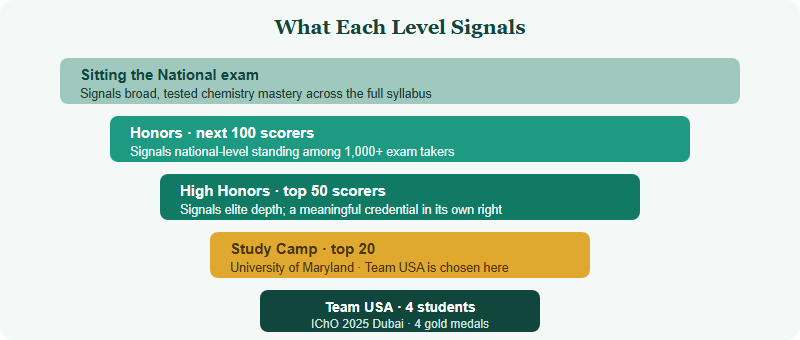
Most students who engage seriously with the USNCO will never make Team USA — and the system still rewards them. At the National Chemistry Olympiad exam, recognition follows performance bands: the top 50 scorers nationally earn High Honors, and the next 100 earn Honors. These designations are credentials in their own right, independent of whether a student advances to the Study Camp. They signal that, among the 1,000-plus students who reached the National exam — themselves drawn from roughly 10,000 local entrants — you placed near the top.
The value of those bands is in what they certify, not what they promise. High Honors signals demonstrated mastery across a demanding three-part exam — a 60-question multiple-choice paper, an extended free-response paper, and a hands-on laboratory practical. Honors signals strong national standing one tier below. The table below sets out the bands and the depth each one reflects, so you can judge the value against the work required.
| Level | Roughly who | What it signals | What it does not |
|---|---|---|---|
| Sat National exam | 1,000+ students nationwide | Tested mastery across the full chemistry syllabus and three exam formats | Not a ranking or award by itself |
| Honors | Next 100 scorers | Strong national-level standing in competition chemistry | Not a Study Camp invitation |
| High Honors | Top 50 scorers | Elite depth; a meaningful standalone credential | Not a guaranteed Team USA place |
| Study Camp | Top 20, University of Maryland | National-team contention; intensive theory and lab training | Not a guaranteed IChO selection |
| Team USA / IChO | 4 students | The pinnacle — e.g. 4 gold at IChO 2025 Dubai | Not replicable by participation alone |
Where the real value lies for students in China
Here the honesty matters most. The USNCO is for U.S. high-school students who enter through an ACS Local Section, and there is no individual sign-up from abroad. Eligibility is set by ACS — if you are based in China, do not assume you can register for or compete in the USNCO directly; confirm any eligibility question on the official ACS channels. We cover this in full in Can International Students Take the USNCO? The value of the USNCO for a student in China therefore does not come from sitting the exam — it comes from two other things.
The first is understanding the system: knowing how a world-class chemistry pipeline is structured, what its top tier produces (the 2025 gold sweep is your benchmark), and how the National exam is built lets you calibrate your own preparation against the highest standard. The second, and most practical, is the public resource library. The USNCO publishes its past papers from 1999 to 2025 with answer keys, alongside the official syllabus — among the best chemistry-olympiad practice materials anywhere, and free to study. That is where "is it worth it?" becomes a clear yes: the material delivers real value regardless of eligibility.
How to use the past papers without sitting the exam
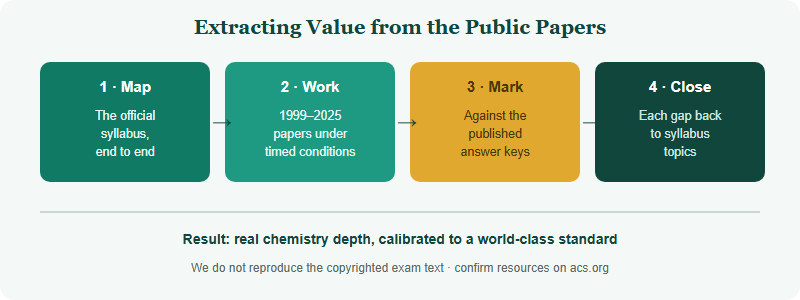
We do not reproduce the copyrighted exam text here; the productive method is to work with the official papers directly. Treat each year's paper as a timed assessment: attempt the 90-minute multiple-choice section against the clock, then the free-response style, marking against the published keys. Map every error back to a syllabus topic and study that topic before the next paper. Repeating this across the 1999–2025 library trains the same speed and rigour the exam demands — skills that transfer to any rigorous chemistry pathway a student in China is eligible for, from school-level olympiads to university study.
This is also where the "is it worth it?" answer is most decisively positive. A student who cannot enter the USNCO can still extract nearly all of its preparatory value — the depth, the discipline, the exposure to a world-class problem set — at zero cost. The one thing that does not transfer is the official recognition band, which requires eligibility to sit the exam. For how the syllabus maps to the papers, see The USNCO Syllabus: What Chemistry It Actually Covers, and for the path beyond the National exam, From USNCO to the IChO.
So, is it worth it? An honest verdict
For a U.S. high-school student eligible to enter, the USNCO is worth it if you are prepared to do the work: High Honors and Honors are genuine credentials, and the pathway can lead, for a very few, to an IChO medal of the kind Team USA earned in Dubai. It is not worth it as a box to tick or a guaranteed admissions lever — those expectations misread what the result signals. For a student in China, the verdict is clearer still: you cannot sit the exam, but the public past papers and syllabus offer outstanding value, and engaging with the system seriously builds the deep chemistry mastery that any selective science pathway rewards. Always confirm eligibility and current details on the official ACS channels.
Frequently asked questions
Did Team USA really win 4 gold at IChO 2025?
Yes. At the International Chemistry Olympiad 2025 in Dubai, all four members of Team USA won gold medals. Confirm results on acs.org.
What do High Honors and Honors signal?
High Honors marks the top 50 national exam scorers; Honors the next 100. Both signal elite chemistry depth — not a guaranteed award or admission.
Is the USNCO worth it for students in China?
You cannot enter from abroad, but its public 1999–2025 past papers and syllabus offer outstanding value for building real chemistry mastery.
Does USNCO success guarantee university admission?
No. It is a strong signal of chemistry depth, not a guarantee of any specific outcome. Confirm eligibility on the official ACS channels.
This is the U.S. National Chemistry Olympiad (USNCO) information desk, synchronising the official competition information — dates, rules, the syllabus, past papers and results — for chemistry students in China, operated by Hanlin Education. The USNCO is run by the American Chemical Society (ACS), which sets all official rules and eligibility; the information here is synced from official ACS sources. Always confirm current details on acs.org. Confirmed errors are corrected within 7 working days.