The USNCO National Exam past papers (1999–2025) are among the strongest chemistry-olympiad practice materials in the world — a quarter-century of calibrated, committee-built problems. We have collected the whole run, organised it by year, and built worked solutions for many of them (with more added over time), so you can train from one place instead of hunting. To use the pack well, work it under timed conditions, cover all three exam parts — multiple choice, free response and (where you can) the practical — track which topics fail you, and build depth over months, not days.
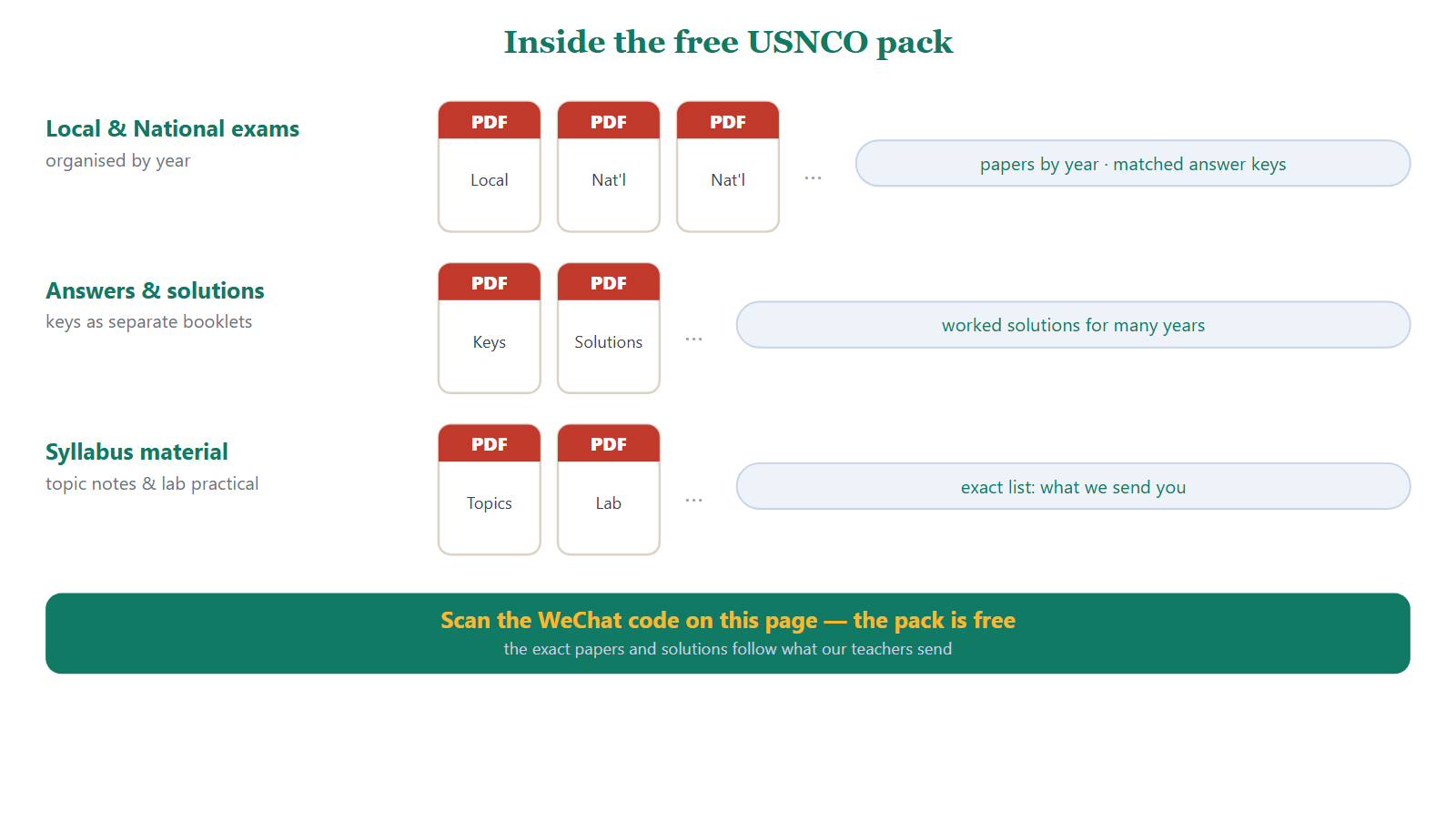
📥 Get the USNCO past-paper pack (1999–2025) — free
The full archive organised by year, with worked solutions for many years (our teachers are adding more over time), plus the syllabus map. Scan the WeChat code on this page and message us — we'll send you the current set and tell you exactly which years are included.
Why these papers are worth your time
Most practice question banks are written quickly and edited little. The USNCO papers are the opposite: each year's National Exam is built by an ACS committee, sat by more than 1,000 advancing students, and accompanied by a worked answer key. That gives you a quarter-century of calibrated, peer-reviewed problems — 1999 through 2025 — spanning the full first-year university chemistry syllabus. They are rigorous and internally consistent — exactly what serious practice should be.
There is a second, quieter advantage. Because the same competition has run since 1984 and the papers stretch back to 1999, the difficulty is remarkably stable year to year. That consistency means a paper from 2012 is still a fair gauge of where you stand against one from 2024 — so you can measure progress honestly across a long preparation, something a random online problem set can never give you. A topic you score 50% on in an older paper and 80% on six weeks later is real, comparable improvement.
A point of honesty first. The USNCO is an official ACS competition for U.S. high-school students, who enter through an ACS Local Section; there is no individual sign-up from abroad. So for a student in China, the value is not the exam seat — eligibility is set by ACS, and you should confirm any participation question on the official ACS channels. The value is the material itself: our organised past-paper pack and the published syllabus are an excellent way to reach a high standard in competition chemistry, whether or not you ever sit the exam. For the full structure, see our guide to what the USNCO is and the four-tier pathway.
Know the exam you are practising for
Before you open a paper, know its shape. The National Exam has three parts, and each rewards a different skill. The papers in the pack mirror the written parts; the practical is harder to replicate at home, which is exactly why most self-studiers neglect it — and why building even a partial routine around it sets you apart.
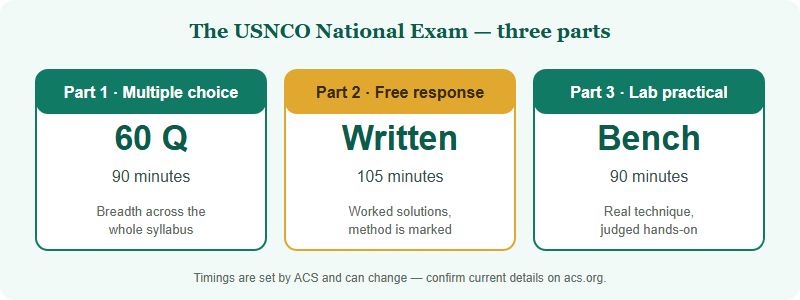
The recognition tiers tell you the standard you are aiming at: nationally, the top 50 earn High Honors and the next 100 earn Honors. You do not need those exact placements to benefit — but they are a useful yardstick for how demanding the written papers are.
A month-by-month way to work the papers
Depth beats cramming. The single most common mistake we see is treating a past paper as a one-off test taken the week before something, rather than as a training tool used in cycles over months. Below is a practical sequence built around the 1999–2025 pack. Adjust the months to your own start date; the order matters more than the calendar.
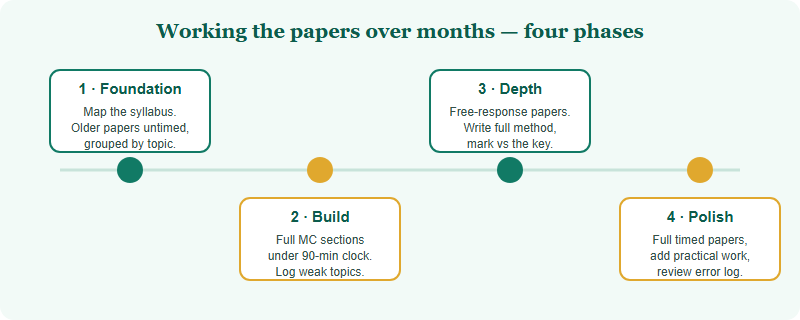
A few principles run through all four phases:
- Use the answer key as a teacher, not a scoreboard. After every paper, read the worked solutions for the questions you missed and for the ones you guessed right. Understanding why an answer is correct is where the learning lives.
- Save your most recent years for last. The 2023–2025 papers best reflect the current style; if you burn them early under no time pressure, you lose your best timed dress rehearsals.
- Practise the free-response in full. Multiple choice is seductive because it is quick to mark, but the free-response paper is where depth is built. Write complete, structured solutions — units, significant figures, balanced equations — then mark yourself honestly against the key.
- Do not skip the practical. You may not have a lab, but you can still study the practical questions: read the procedure, predict the calculations, work the data-analysis steps, and rehearse error and uncertainty reasoning. That habit is rare and valuable. For a full study plan, see how to prepare for the USNCO.
Track your topics — the part most students skip
Doing papers without a record is how people plateau. The students who improve fastest keep a simple error log: every missed question, tagged by topic, with a one-line note on why it went wrong. After a handful of papers, patterns appear — and they are almost never random. Below is a compact view of the recurring topic areas in the written exam and the kind of failure each tends to produce. Use it to turn a stack of marked papers into a targeted revision list.
| Topic area | Typical question form | Common failure to log & fix |
| Stoichiometry & solutions | Limiting reagent, concentration, dilution | Unit slips; molarity vs molality confusion |
| Thermodynamics | Enthalpy, entropy, Gibbs free energy, Hess's law | Sign errors; mixing up system vs surroundings |
| Equilibrium | K expressions, ICE tables, Le Châtelier, buffers | Dropping the −x term; pH/pKa setup errors |
| Kinetics | Rate laws, order determination, Arrhenius | Confusing rate constant with rate; graph misreads |
| Electrochemistry | Cell potentials, Nernst, electrolysis | Anode/cathode mix-ups; electron-count errors |
| Atomic & bonding | Periodic trends, VSEPR, MO basics | Geometry vs hybridisation; trend exceptions |
| Organic | Functional groups, mechanisms, isomerism | Missing stereochemistry; reagent recall gaps |
This grouping is a study aid for organising your own practice, not an official ACS weighting. The exact distribution is set by ACS each year — treat the published syllabus as the authority.
Where the papers fit a serious prep plan
Past papers are the engine of preparation, but they are not the whole car. The strongest routine pairs them with a textbook for the topics your error log exposes, so that a missed equilibrium question sends you back to the chapter rather than just to the answer key. Work in cycles — learn, test on a paper, log gaps, relearn — and the same loop that builds a National-standard candidate will build real chemistry depth for any student, including those who can never sit the exam.
A realistic weekly rhythm during a serious build phase looks like this: one full timed section (a multiple-choice block, or a free-response paper), one slower review session spent only on the questions you got wrong and the relevant textbook pages, and one short maintenance session revisiting last month's worst topic to check it has stuck. Three focused sittings a week, sustained over a few months, will take you far further than a weekend of frantic full papers before a deadline. As ACS noted, Team USA won four gold medals at the 2025 International Chemistry Olympiad in Dubai; that ceiling is reached through years of exactly this kind of deliberate, paper-driven practice, not last-minute effort.
Ready to start? Get the pack free.
Scan the WeChat code on this page and message us for our organised USNCO past-paper pack (1999–2025), with worked solutions for many years and the syllabus map — free. Tell us your level and we'll point you to the right years to start with.
Frequently asked questions
How do I get the USNCO past papers?
Scan the WeChat code on this page and message us. We'll send you our organised 1999–2025 pack with the syllabus map and worked solutions for the years we have them, free of charge.
Do the papers come with worked solutions?
Many of the years do, and our teachers are adding more over time — coverage varies by year, so we'll tell you exactly which are included when you request the pack.
Can I prepare with them if I am not in the U.S.?
Yes — the papers and syllabus are excellent study material for any chemistry student. But the USNCO itself is for U.S. high-school students via an ACS Local Section; confirm any eligibility on official ACS channels.
How many years of papers should I work through?
Aim for several years across all three parts. Use older papers untimed to learn, and save the most recent 2023–2025 papers for full timed practice closer to your goal.
This is the U.S. National Chemistry Olympiad (USNCO) information desk, synchronising the official competition information — dates, rules, the syllabus and results — for chemistry students in China, operated by Hanlin Education. The USNCO is run by the American Chemical Society (ACS), which sets all official rules and eligibility; always confirm current rules, dates and eligibility on acs.org. Confirmed errors are corrected within 7 working days.