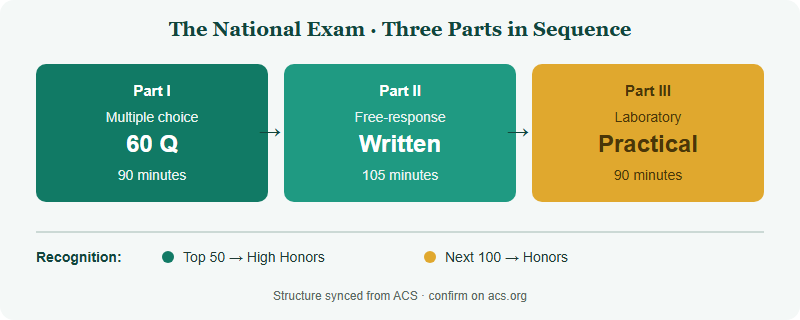
The USNCO National Exam, sat in 2026 between 10 and 19 April, is a three-part assessment: Part I is 60 multiple-choice questions in 90 minutes, Part II is a free-response written paper of 105 minutes, and Part III is a 90-minute laboratory practical. Together they run roughly four and a half hours of testing. Run by the American Chemical Society (ACS), the exam decides who advances to the Study Camp. Confirm the current format on acs.org.
Where the National Exam sits in the USNCO pathway
The National Exam is the second of four tiers. Students reach it only after being nominated by an ACS Local Section — or, for eligible U.S. citizens and permanent residents studying abroad, by an ACS International Chemical Sciences Chapter — on the strength of the Local Chemistry Olympiad (27 February–16 March in 2026). More than 1,000 nominated students sit the national round, and the top performers are invited to the residential Study Camp at the University of Maryland, where the four-member Team USA is selected for the International Chemistry Olympiad. For the full route from Local to IChO, see our companion explainer, What Is the USNCO.
What makes the national round a genuine step up is not just difficulty but breadth of skill. A single multiple-choice paper rewards fast recall; the National Exam deliberately tests three different competencies in sequence — rapid reasoning, extended written problem-solving, and hands-on laboratory technique. A student strong in one and weak in another will feel it. That is the central design fact worth internalising before any preparation begins.
Part I · Multiple choice (60 questions, 90 minutes)
Part I is a 60-question multiple-choice paper with a 90-minute limit — an average of about 90 seconds per question. The format rewards a wide, secure command of the syllabus rather than deep work on any single problem. Questions span the breadth of a strong general-chemistry course: stoichiometry, atomic and molecular structure, periodicity, bonding, states of matter, thermochemistry, equilibrium, acid–base and redox chemistry, kinetics, electrochemistry, and core organic and descriptive chemistry.
Because the clock is tight, pace and recognition matter as much as raw ability. A student who can identify a question type instantly — “this is a limiting-reagent calculation,” “this is a Hess's-law cycle” — saves the seconds that decide a Part I score. A periodic table is provided; memorised process, not memorised data, is what the timing rewards. This is the tier where working old papers under a real 90-minute clock pays off most directly, because the skill being trained is throughput.
Part II · Free-response written paper (105 minutes)
Part II is the longest single component at 105 minutes and the one that most resembles university-level chemistry. Here, the answer is not a letter but a full worked solution: students must show method, carry units correctly, draw mechanisms and structures, and justify reasoning. Partial credit is the rule, so a clearly set-out attempt that reaches most of the way is worth far more than a blank space or an unexplained final number.
Typical demands include multi-step quantitative problems (equilibrium, thermodynamics, electrochemistry), organic reaction mechanisms and synthesis, and short structured questions that build from a shared stem. The premium is on rigour and communication: a grader has to follow your logic. Students who train only with multiple-choice papers are often surprised here, because Part II punishes the habit of jumping to an answer. The discipline to write chemistry the way a marker reads it is, itself, a learnable skill — and it is exactly what the free-response sections of the public past papers train.
Part III · The laboratory practical (90 minutes) — the distinctive part
The laboratory practical is what sets the USNCO National Exam apart from almost every paper-only chemistry competition. For 90 minutes, students work at the bench — performing real wet-lab procedures and being assessed on technique, observation, and the quality of their data, not just a final figure. It is the part that cannot be faked by recall, and the part students based outside the U.S. most often overlook when they picture the exam.
A practical session typically asks students to carry out and interpret hands-on tasks such as:
- Volumetric analysis (titration): preparing solutions, reading a burette accurately, identifying an endpoint, and propagating measurement uncertainty into the final result.
- Qualitative analysis: using systematic tests and observations to identify unknown ions or compounds, and recording evidence cleanly.
- Quantitative measurement: gravimetric or calorimetric work where careful technique and honest data recording drive the marks.
- Safe, methodical bench practice: correct apparatus handling, appropriate use of safety equipment, and a tidy, reproducible workflow.
Because the practical rewards genuine laboratory hours, it is the hardest part to prepare for purely from books. Marks come from accuracy and from how an experiment is conducted and reported: a precise endpoint with a well-presented uncertainty estimate scores where a guessed number does not. For any student building real chemistry depth — whatever competition they are eligible for — supervised lab time and honest data discipline are the investment that this part values most. Specific apparatus, reagents and the safety brief vary by year, so treat the list above as illustrative and confirm current arrangements on acs.org.
| Part | Format | Time | What it tests | How marks work |
|---|---|---|---|---|
| Part I | 60 multiple-choice questions | 90 min | Breadth of the syllabus · speed of reasoning | Each question scored right/wrong; pace is decisive |
| Part II | Free-response written paper | 105 min | Worked solutions, mechanisms, quantitative depth | Method-based partial credit; show all working |
| Part III | Laboratory practical | 90 min | Technique, observation, accuracy of real data | Credit for procedure & data quality, not just the answer |
How marks and recognition work
National recognition is awarded on overall performance across the three parts, in bands: the top 50 scorers nationally earn High Honors, and the next 100 earn Honors. These are meaningful credentials in their own right, even for students who do not advance further. The very top performers — broadly the leading 20 — are invited to the Study Camp, the residential stage where Team USA is ultimately chosen; we cover that selection in detail in The USNCO Study Camp & How Team USA Is Chosen.
A practical implication of the partial-credit structure is that completeness across parts usually beats brilliance in one. Because Part II awards method marks and Part III rewards clean procedure, students who leave nothing blank and present their reasoning tend to out-score those who chase a perfect Part I and stall elsewhere. The exact weighting between parts and the cut-offs are set by ACS and can change year to year, so confirm any current detail on acs.org rather than assuming a fixed split.
How the syllabus maps to the three parts
The USNCO publishes an official syllabus, and the most efficient way to read it is not as a reading list but as a map of where each topic gets tested. The same topic can appear in all three parts in very different forms. The diagram below shows how the core syllabus areas distribute across Part I (recognition and speed), Part II (extended written work), and Part III (the bench).
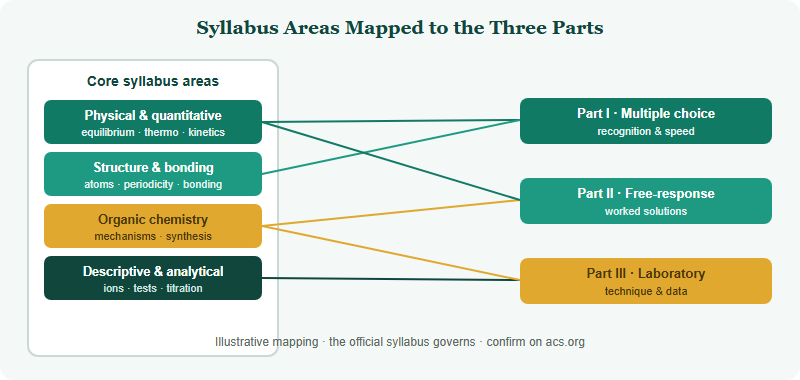
Read this way, the syllabus tells you not only what to study but how to practise each topic. Equilibrium, for instance, appears as a fast recognition item in Part I, as a multi-step worked calculation in Part II, and as a real titration or buffer task in Part III. Studying it once, in one mode, leaves two-thirds of its exam surface untouched.
What this means for students in China
Eligibility honesty comes first — and the honest answer is more precise than a flat no. For this tier ACS sets a hard line: a student must be a U.S. citizen or a legal permanent resident (green-card holder) to take the National Exam. Students who do not meet that criterion, ACS states, can take part only in the Local Exam “without the possibility of being nominated to sit for the National Exam, regardless of their performance (score)”. It is enforced, too: at registration students sign a statement about their legal status, and an exam cannot be accepted without it. It is also true that there is no individual sign-up from abroad — entry always runs through a coordinator at an ACS Local Section or International Chapter rather than an online form a student completes alone. That describes the registration mechanism; it does not by itself mean no route exists. Which of three situations you are in decides the answer:
- At a high school in the United States, on a non-U.S. passport: you may sit the Local Exam through your school's ACS Local Section, but you cannot be nominated to the National Exam whatever you score.
- A U.S. citizen or green-card holder abroad — enrolled for at least a year at an accredited American school (this includes American and international schools in China) and under 20: the full route is open, with the local and national competition organised by an ACS International Chemical Sciences Chapter. ACS's own published lists of national top scorers include students at an American school in Shanghai, one of whom went on to Team USA.
- Not a U.S. citizen or permanent resident, at a school in mainland China: there is no ACS route at any tier. That is the situation most readers of this site are in, and it is the honest answer for them.
Eligibility is set by ACS — confirm any question on the official ACS channels, and for the rules in full see our dedicated guide to who can and cannot enter the USNCO. For the third group, that boundary does not erase the value of the exam; it reshapes how to use it.
The genuine value is twofold. First, understanding the format — the three parts, the timing, the mark logic — lets you benchmark your own chemistry against a world-class standard. Second, the USNCO publishes its past papers from 1999 to 2025 with answer keys, alongside the official syllabus. These are an exceptional, free way to build real depth. We do not reproduce the copyrighted exam text here; the productive method is to work the official papers under timed conditions, mark against the published keys, and map every gap back to the syllabus. For a step-by-step routine, see USNCO Past Papers (1999–2025): How to Use Them to Prepare. And because the practical cannot be learned from paper, pair that reading with supervised lab time wherever you can find it — the technique transfers to any rigorous chemistry pathway.
Frequently asked questions
What are the three parts of the USNCO National Exam?
Part I: 60 multiple-choice in 90 min. Part II: a 105-min free-response written paper. Part III: a 90-min laboratory practical. Confirm on acs.org.
Does the USNCO National Exam really include a lab?
Yes. Part III is a 90-minute hands-on laboratory practical assessing technique, observation and data quality — the exam's distinctive part.
How is the National Exam marked?
Overall across all three parts. Part II gives method-based partial credit; Part III credits procedure and data. Top 50 earn High Honors, next 100 Honors.
Can students in China sit the USNCO National Exam?
Only some. ACS requires U.S. citizenship or permanent residency for the National Exam, so a student in China qualifies only if they hold that status and have been enrolled at least a year at an accredited American school and are under 20 — that route runs through an ACS International Chemical Sciences Chapter. Students without U.S. citizenship or a green card cannot sit it, whatever their score. Confirm eligibility on the official ACS channels.
This is the U.S. National Chemistry Olympiad (USNCO) information desk, synchronising the official competition information — dates, rules, the syllabus, past papers and results — for chemistry students in China, operated by Hanlin Education. The USNCO is run by the American Chemical Society (ACS), which sets all official rules and eligibility; the information here is synced from official ACS sources. Always confirm current details on acs.org. Confirmed errors are corrected within 7 working days.