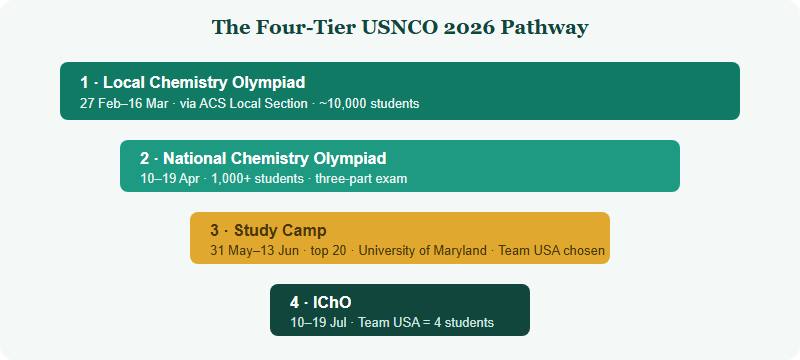
The U.S. National Chemistry Olympiad (USNCO) follows a four-tier pathway in 2026: the Local Chemistry Olympiad (27 February–16 March), the National Chemistry Olympiad exam (10–19 April), a two-week Study Camp (31 May–13 June, University of Maryland), and the International Chemistry Olympiad (IChO, 10–19 July). Run by the American Chemical Society (ACS), it narrows roughly 10,000 students to a four-person Team USA. Confirm all dates on acs.org.
How the four tiers fit together
Founded by ACS in 1984, the USNCO is a multi-stage selection competition, not a single test. Each tier is a filter: only the strongest performers carry forward to the next. The system is deliberately steep — tens of thousands of high-school chemistry students begin at the local level, and exactly four represent the United States at the International Chemistry Olympiad. Understanding this structure is the single most useful thing a student can do before investing months of preparation, because it clarifies what each stage actually tests and how far the road runs.
Entry happens through an ACS Local Section — the regional volunteer chapters of the American Chemical Society spread across the United States. A student does not register individually with a national office; the Local Section coordinates who sits the Local exam. From there, advancement is purely merit-based, decided by exam scores rather than application. For a fuller orientation, see our companion explainer, What Is the USNCO.
Tier 1 · Local Chemistry Olympiad (27 Feb–16 March)
The Local Chemistry Olympiad is the entry point, administered by ACS Local Sections during a window that in 2026 runs from 27 February to 16 March. Roughly 10,000 U.S. high-school students take part each year. The local exam is the broadest tier by participation, and each Local Section decides how many of its top scorers it nominates to advance to the national round. Because Local Sections are regional, the exact local testing date, format and nomination quota vary — students in the U.S. should confirm specifics with their local ACS section.
For students in China, this tier is where eligibility honesty matters most. The USNCO is for U.S. high-school students entering through an ACS Local Section, and there is no individual sign-up from abroad. If you are based in China, treat the Local round as a window into the system rather than an entry route, and confirm any eligibility question on the official ACS channels. Our dedicated explainer covers this directly: Can International Students Take the USNCO? Eligibility, Honestly.
Tier 2 · National Chemistry Olympiad exam (10–19 April)
Students nominated by their Local Sections sit the National Chemistry Olympiad exam, scheduled in 2026 for 10–19 April, with more than 1,000 students nationwide. This is the tier where the competition deepens substantially: the national exam is a rigorous three-part assessment that goes well beyond a single multiple-choice paper. It is also the stage that determines who is invited to the Study Camp.
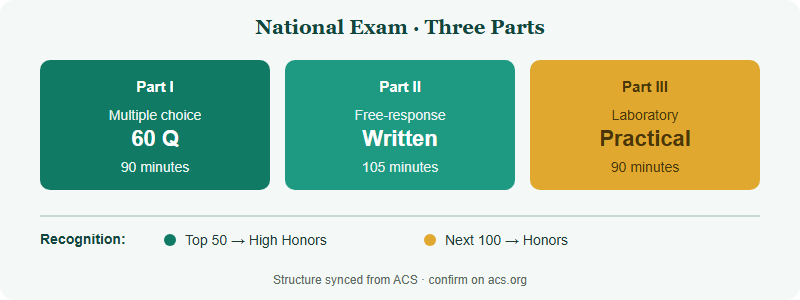
The three parts test different competencies in sequence — rapid recall and reasoning, extended written problem-solving, and hands-on laboratory technique. The table and diagram below summarise the structure. For a deeper walkthrough of each part and the underlying syllabus, see Inside the USNCO National Exam: Format, the Three Parts & Syllabus.
| Tier | 2026 dates | Who is involved | Who advances |
|---|---|---|---|
| Local Chemistry Olympiad | 27 Feb–16 Mar | ~10,000 students, via ACS Local Section | Top scorers nominated by each Local Section |
| National Chemistry Olympiad | 10–19 Apr | 1,000+ students (three-part exam) | Top 20 invited to Study Camp |
| Study Camp | 31 May–13 Jun | Top 20, University of Maryland | Four-student Team USA selected |
| International Chemistry Olympiad | 10–19 Jul | Team USA = 4 students | Competes internationally for medals |
Inside the national exam: three parts
The National Chemistry Olympiad exam is built from three distinct components, each with its own timing and skill focus:
- Part I — Multiple choice: 60 questions in 90 minutes, testing breadth across the chemistry syllabus and speed of reasoning.
- Part II — Free-response written paper: 105 minutes of extended problems requiring full worked solutions, mechanisms and quantitative analysis.
- Part III — Laboratory practical: 90 minutes of hands-on experimental work, assessing technique, observation and data handling.
Recognition at the national level follows performance bands: the top 50 scorers earn High Honors, and the next 100 earn Honors. These designations are a meaningful credential in their own right, even for students who do not progress to the Study Camp.
Tier 3 · Study Camp (31 May–13 June) and Tier 4 · IChO (10–19 July)
The top 20 performers on the national exam are invited to the USNCO Study Camp, held in 2026 from 31 May to 13 June at the University of Maryland. The camp is an intensive residential program combining advanced theory, laboratory training and further examinations. Its purpose is selection as well as preparation: from these 20 students, the four-member Team USA is chosen to compete at the International Chemistry Olympiad.
The International Chemistry Olympiad, scheduled in 2026 for 10–19 July, is the apex tier. Team USA — exactly four students — competes against national teams from around the world. The American team has a strong recent record: at IChO 2025 in Dubai, all four U.S. team members won gold medals. That outcome illustrates the depth the four-tier system is designed to produce, and it is the kind of result that takes years of disciplined chemistry study to reach.
What this means for students in China
Eligibility for the USNCO is set by ACS and limited to U.S. high-school students who enter via a Local Section; there is no overseas individual registration. For students in China, the honest and genuinely valuable approach is twofold. First, understand the system — knowing how the four tiers, dates and exam format work lets you benchmark your own preparation against a world-class standard. Second, use the public resources: the USNCO publishes its past papers from 1999 to 2025 with answer keys, alongside the official syllabus.
Those past papers and the syllabus are an exceptional, free way to build real chemistry depth. We do not reproduce the copyrighted exam text here; instead, the productive method is to work through the official papers under timed conditions, mark against the published keys, and map every gap back to the syllabus topics. Practising the 90-minute multiple-choice format and the free-response style trains both speed and rigour — skills that transfer to any rigorous chemistry pathway, regardless of which competition a student is eligible for. For eligibility specifics, always confirm on the official ACS channels.
Frequently asked questions
What are the four tiers of the USNCO?
Local Chemistry Olympiad, National Chemistry Olympiad, Study Camp, and the International Chemistry Olympiad (IChO). Each tier filters to the next on merit.
When is the USNCO in 2026?
Local 27 Feb–16 Mar, National 10–19 Apr, Study Camp 31 May–13 Jun, IChO 10–19 Jul. Confirm current dates on acs.org.
Can students in China enter the USNCO?
No. It is for U.S. high-school students via an ACS Local Section; there is no sign-up from abroad. Confirm eligibility on the official ACS channels.
How does the national exam work?
Three parts: 60 multiple-choice in 90 min, a 105-min written paper, and a 90-min lab practical. Top 50 earn High Honors, next 100 Honors.
This is the U.S. National Chemistry Olympiad (USNCO) information desk, synchronising the official competition information — dates, rules, the syllabus, past papers and results — for chemistry students in China, operated by Hanlin Education. The USNCO is run by the American Chemical Society (ACS), which sets all official rules and eligibility; the information here is synced from official ACS sources. Always confirm current details on acs.org. Confirmed errors are corrected within 7 working days.